Story & history.
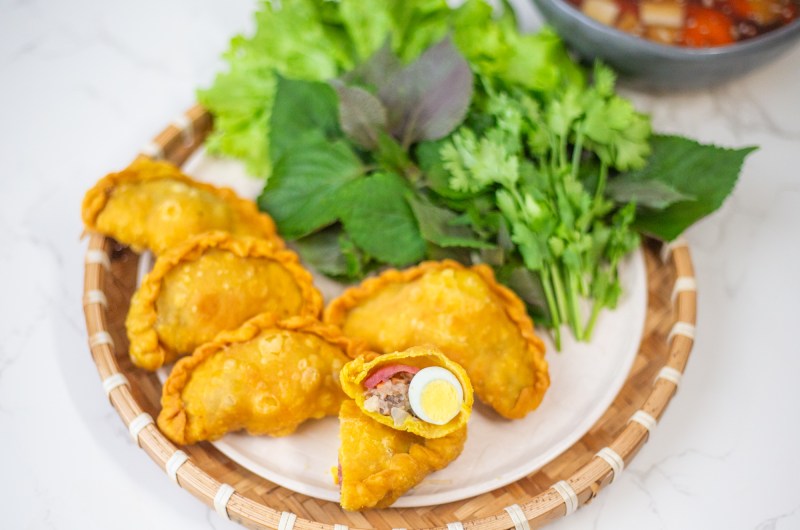
Banh goi is Hanoi's distinctive half-moon crispy fried dumpling — a golden, shattering wheat flour shell enclosing a filling of sautéed pork, glass noodles, wood ear mushrooms, and onion, deep-fried to even golden crispiness — a sidewalk snack that Hanoians eat at any time of day from morning to midnight. The name 'banh goi' evokes the shape of a small pillow — wheat flour is rolled thin, filling placed in the center, edges folded over and crimped tightly with fingers to create a half-circle with a characteristic pleated border. Banh goi belongs with banh ran man (savory fried dumplings) and nem ran (fried spring rolls) to form the classic 'deep-fried snack trio' of Hanoi street food — typically sold together at small sidewalk stalls with a sweet-sour dipping sauce of vinegar, sugar, and chili — no fish sauce by Hanoi tradition of vinegar, sugar, and chili. A good banh goi shell must achieve a dual standard: outer layer shattering crisp but not hard, with the inside of the shell retaining slight chewiness from wheat flour not over-fried — the razor-thin line between perfect crispiness and dried-out crunch is the technical challenge of every banh goi maker.
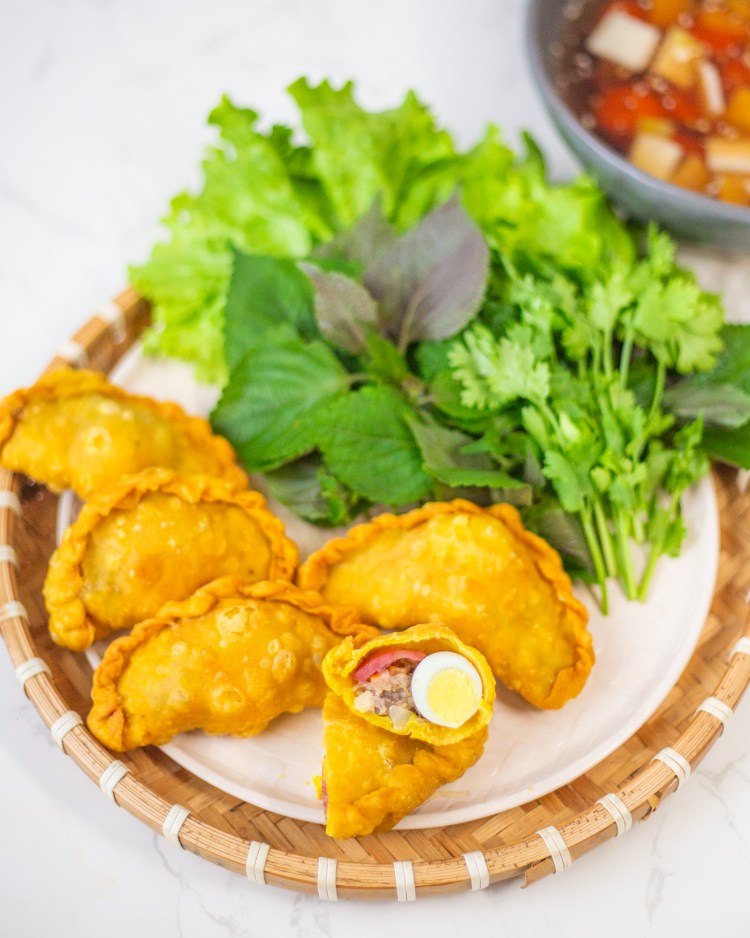
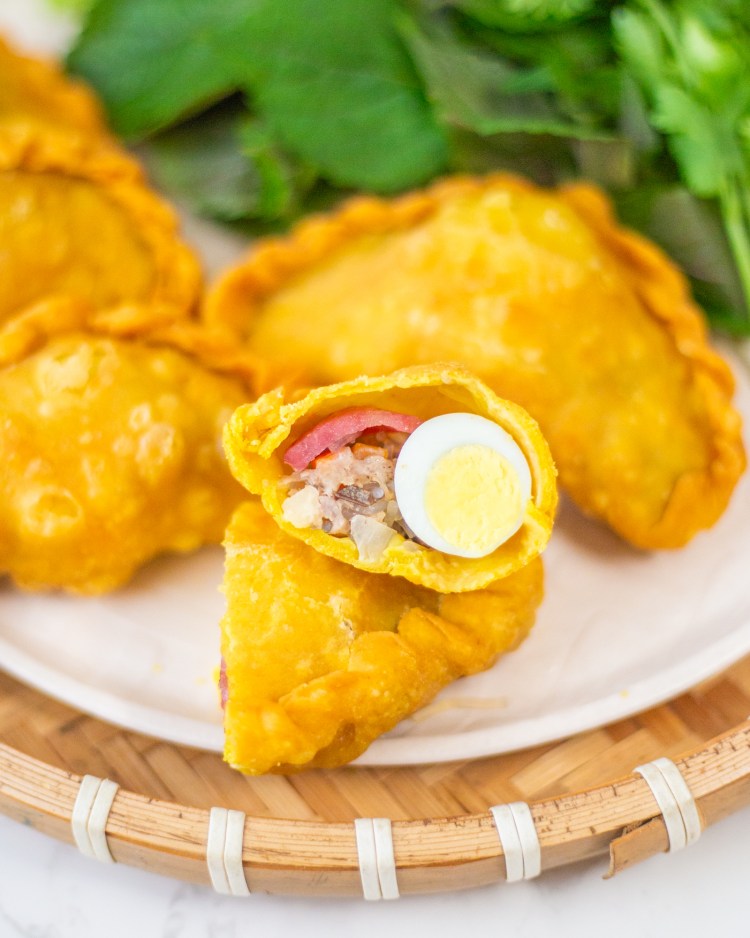
The traditional Hanoi banh goi filling has fixed components: ground pork, softened glass noodles cut into segments, ground wood ear mushrooms, diced onion, and raw egg — all mixed well and seasoned with fish sauce, pepper, and sugar. The proportion of noodles and wood ear mushrooms is critical: too many noodles and the filling is bland, too few and the mixture lacks binding. The shell dough is typically made from wheat flour with a small amount of tapioca starch for chewiness and crispiness — dough too stiff is hard to roll thin, too wet will not hold its shape after folding. Frying oil must be hot enough — approximately 170–180°C — for the shell to puff and crisp immediately on contact with oil without absorbing oil and softening the crust. Banh goi is best eaten just lifted from the frying oil while still piping hot — within just a few minutes of cooling the shell softens and loses most of its appeal.
Hanoi banh goi is not just a snack but an urban memory — Hanoians recall afternoons buying hot banh goi from street vendors at street corners after school, or late nights stopping at small sidewalk stalls on the way home. Hang Dieu street, Lo Su, and the area around Hoan Kiem Lake have many banh goi stalls open until 11–12 PM serving those seeking a familiar flavor at the end of a long day. While many Hanoi street foods are gradually disappearing or being modernized, banh goi has maintained its traditional form and flavor — perhaps because its simplicity and perfection leave nothing to improve upon. Biting into a piping hot, shattering-crisp banh goi on a Hanoi sidewalk — this is one of the purest and most inexplicable culinary joys of Vietnamese urban life.
A Hanoi winter without holding a hot bánh gối while huddled on a pavement stool is a winter not truly lived in Hanoi.
— Câu nói dân gian Hà Thành
Ingredients — what makes the flavour.
A good bánh gối should be an even golden colour from the body to the crimped edges — no white patches (undercooked) or dark-brown spots (overcooked). Tap the crust lightly with a finger; it should sound hollow and crisp, not soft or deflated. If oil runs out when you bite into it, the frying oil was not hot enough — look for a different stall.
How to enjoy it properly.
How to eat bánh gối the Hanoi way
Bánh gối must be eaten the moment it leaves the oil — the crust is at its crispiest in the first five minutes. Bite off a small corner first to let the steam from the filling escape before you take a full bite, and listen for the distinctive crunch — that sound tells you the pastry is properly made.
Dip into the sweet-sour sauce and drag along some shredded green papaya — the contrast between the rich, crispy shell and the cool, tart dipping sauce is the soul of this snack. Never pour the sauce over the pastry; it will immediately soften the crust.
Eating bánh gối like a Hanoian
By tradition, bánh gối is eaten standing or perched on a low pavement stool — it is not restaurant food. A glass of iced tea or sorrel juice is how Hanoians balance the richness after a few pastries in a row. If the stall also sells bánh rán (sweet sesame doughnuts), try both — different in flavour but equally at home in the world of traditional Hanoi fried snacks.
Editor-recommended eateries.
ⓘ Addresses and prices may change. Please verify before visiting.