History & story.
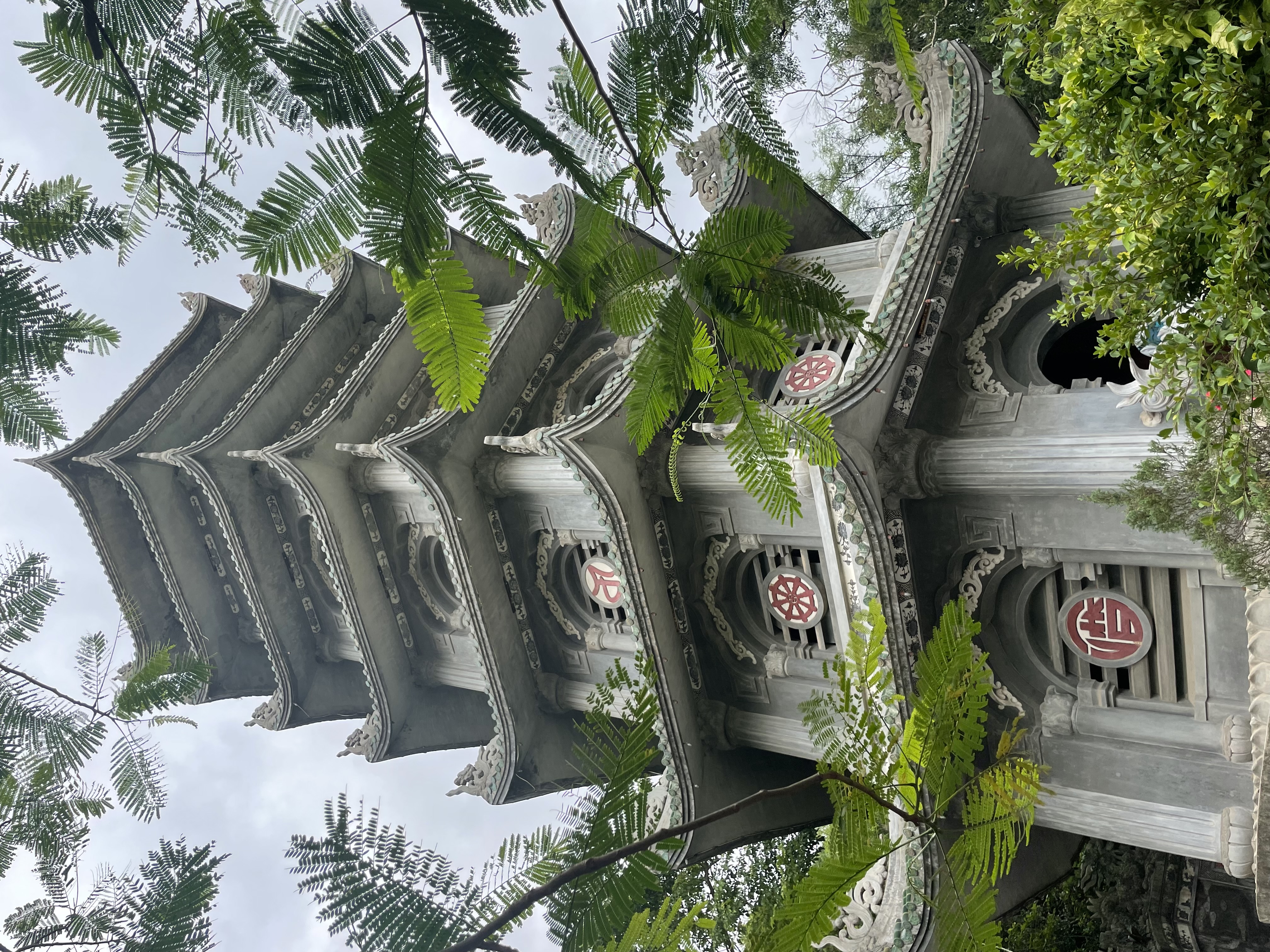
Marble Mountains — five marble and limestone peaks named Kim (Metal), Moc (Wood), Thuy (Water), Hoa (Fire), and Tho (Earth) after Eastern philosophical elements — rise dramatically from Da Nang's coastal plain. Only Thuy Son is open to visitors, standing 106 metres tall with a cave network housing temples and Buddha statues carved into the rock face across many centuries. Emperor Minh Mang of the Nguyen dynasty personally toured and named all five peaks in 1825, commissioning stone inscription plaques that survive intact today. French scholar Henri Parmentier documented ancient Cham inscriptions inside Tang Chon Cave in the early 20th century, confirming that the site's religious history spans from Cham civilisation through the Nguyen court to the present day.
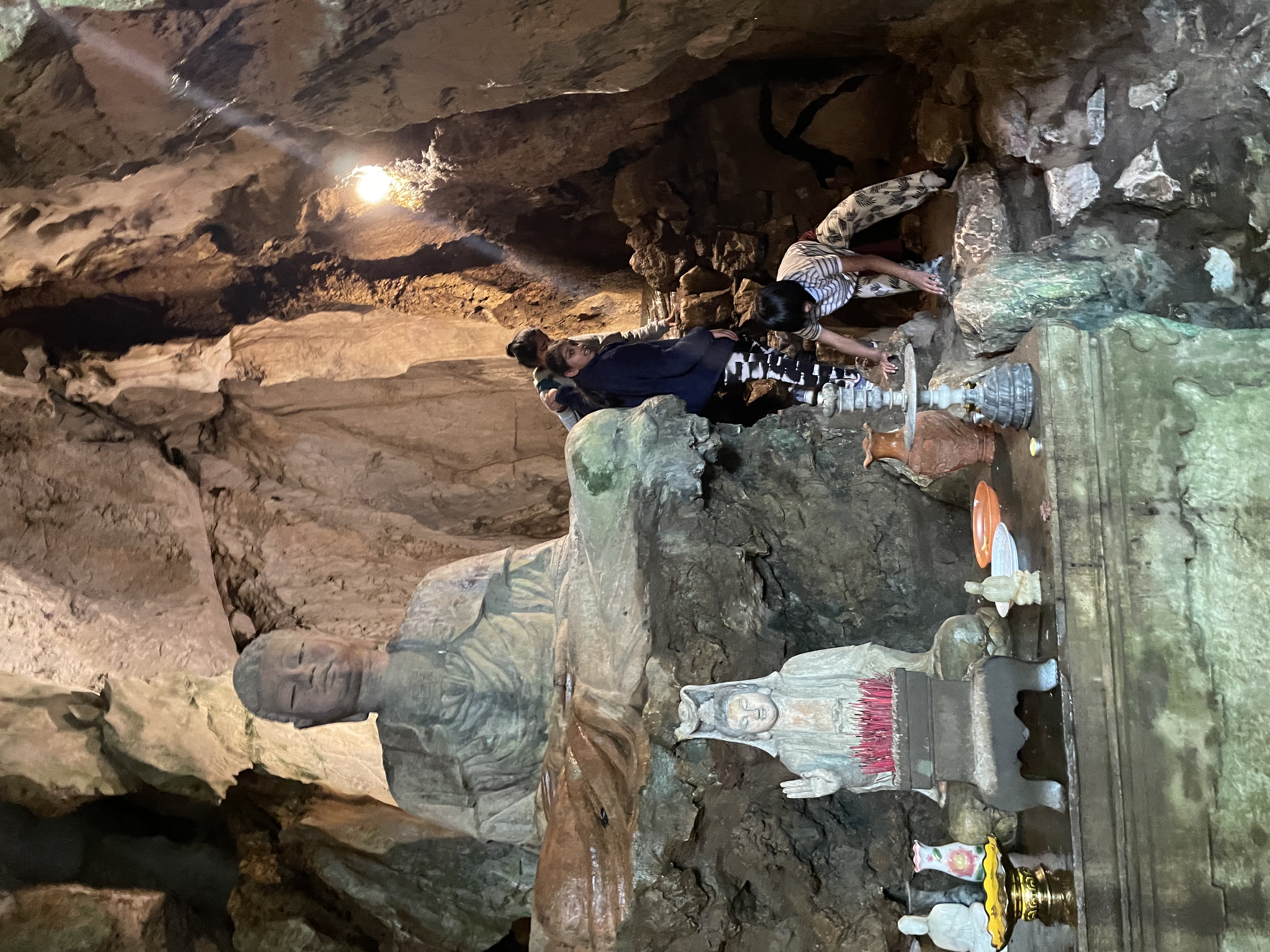
Huyen Khong Cave is the centrepiece of the Marble Mountains experience. The spacious chamber has a naturally vaulted ceiling tens of metres high, and three skylights allow light to filter in, creating a magical interplay of light and shadow that shifts by the hour. Precisely at noon, a single beam strikes directly onto the main Buddha altar — a moment that hundreds of pilgrims and tourists sit silently to witness each year. Cave walls bear shrapnel marks from the Vietnam War, when the chamber served as a covert military base thanks to its rugged access and natural tunnel network. Together with Tang Chon Cave (rare stalactites) and Am Phu Cave (folk hell imagery), Thuy Son possesses a cave system of thematic and aesthetic diversity rarely matched at any tourist site in Vietnam.
Non Nuoc stone-carving village at the foot of Marble Mountains has more than 400 years of history — the first craftsmen are thought to have accompanied Nguyen lords' forces to the area in the 17th century and began quarrying marble directly from the mountains. Today hundreds of workshops produce Buddha statues and decorative pieces in white, pink, and green stone exported worldwide — Japanese, American, and European buyers are all regular clients. The constant tap-tap of chisels is the neighbourhood's unmistakable signature sound. To preserve the natural morphology of the peaks, since the 1990s stone has been imported from Nghe An province rather than quarried on site — a significant conservation decision in Da Nang's geological protection history. Buying directly at workshops lets you watch artisans work and saves 30–50% compared to tourist shops.
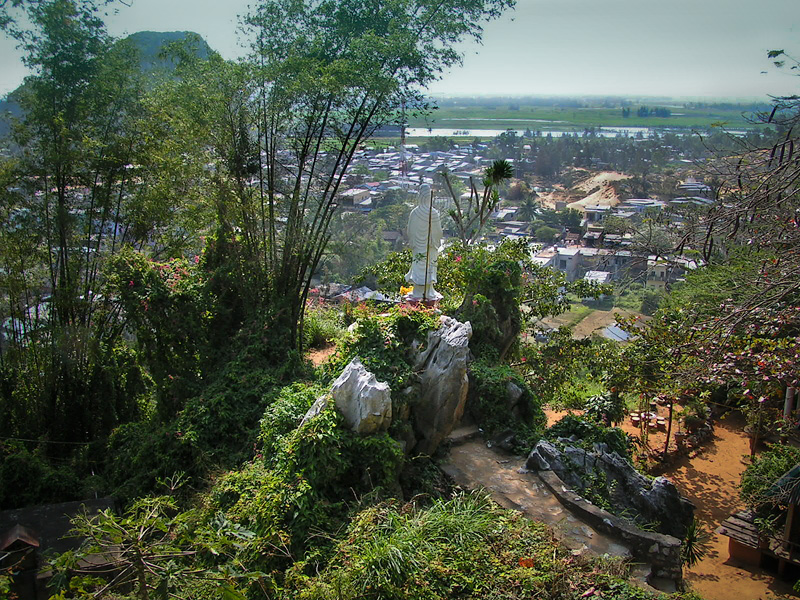
During the Vietnam War, Marble Mountains became an operational base for National Liberation Front forces thanks to the extensive cave network and rugged terrain — artillery marks and wartime inscriptions from that era remain visible in several chambers. The heritage complex was designated a National Historical Site and Scenic Landscape in 1980 and is currently advancing through the UNESCO World Heritage nomination process. Standing at the Vong Hai Dai viewpoint atop Thuy Son, visitors see My Khe Beach stretching northward, Hoi An's ancient town emerging to the south, and modern Da Nang spread behind — a 360-degree panorama where sea, mountain, city, and centuries of history intersect in a way found nowhere else in the region.
Light from heaven piercing the mountain rock to illuminate the Buddha — that is not a miracle, that is the architecture of the cosmos.
Khắc trên vách đá, hang Huyền Không / Carved inscription, Huyen Khong Cave
Highlights not to miss.
Huyen Khong Cave is the largest and most mysterious chamber in Thuy Son's cave system, with a soaring ceiling and three natural skylights (called 'heaven holes') that allow sunlight to enter from above. Precisely at midday when the sun reaches its zenith, a single beam strikes directly onto the main Buddha altar at the cave's centre — a natural optical phenomenon that pilgrims regard as a manifestation of divine blessing. The cave served as a covert wartime base: bullet and shrapnel marks from Vietnam War-era combat are still visible on the cave walls. This is the unmissable highlight of Marble Mountains — arrive before 8 am for the quiet space to absorb the cave's full mystery.
Marble Mountains comprises five limestone and marble peaks named after the five cosmic elements in Eastern philosophy: Kim (Metal), Moc (Wood), Thuy (Water), Hoa (Fire), and Tho (Earth). Emperor Minh Mang of the Nguyen dynasty personally toured and named all five peaks in 1825, commissioning stone inscription plaques to mark the occasion — those original plaques survive intact today. Only Thuy Son (Water Mountain) is fully open to visitors; it is also the tallest at 106 metres with the most extensive cave system. The other four peaks, admired from a distance, display a distinctive geological morphology — jagged forms jutting sharply from the flat coastal plain like the enormous teeth of some buried titan.
While Huyen Khong draws most visitors, Tang Chon Cave offers a quieter space with rare stalactites and intricately carved Buddha shrines — French scholar Henri Parmentier documented ancient Cham inscriptions here in the early 20th century. Am Phu Cave delivers an entirely different experience: inside is a sculptural complex depicting hell and purgatory according to Vietnamese folk belief — vividly carved stone demons punishing sinful souls set into the cave walls. Am Phu has a separate entrance and charges an additional fee; it is a unique stop for those who want a deeper understanding of the cosmological worldview in traditional Vietnamese spirituality. All three caves together create a philosophical journey — from heaven, through the present, to the underworld — within a single mountain.
Non Nuoc stone-carving craft village at the foot of Marble Mountains is one of Vietnam's oldest handicraft settlements, with over 400 years of tradition sculpting marble quarried from the mountains themselves — though today stone is imported from elsewhere to preserve the topography. Hundreds of workshops produce Buddha statues, decorative pieces, and souvenirs in white, pink, and green stone exported worldwide. The constant tap-tap of chisels fills the air as the area's defining soundtrack — entering the village is entering a space where the rhythm of traditional handicraft has never been interrupted by the industrial age. Buying directly from workshops costs 30–50% less than tourist shops in the city, and visitors can watch artisans working at their benches.
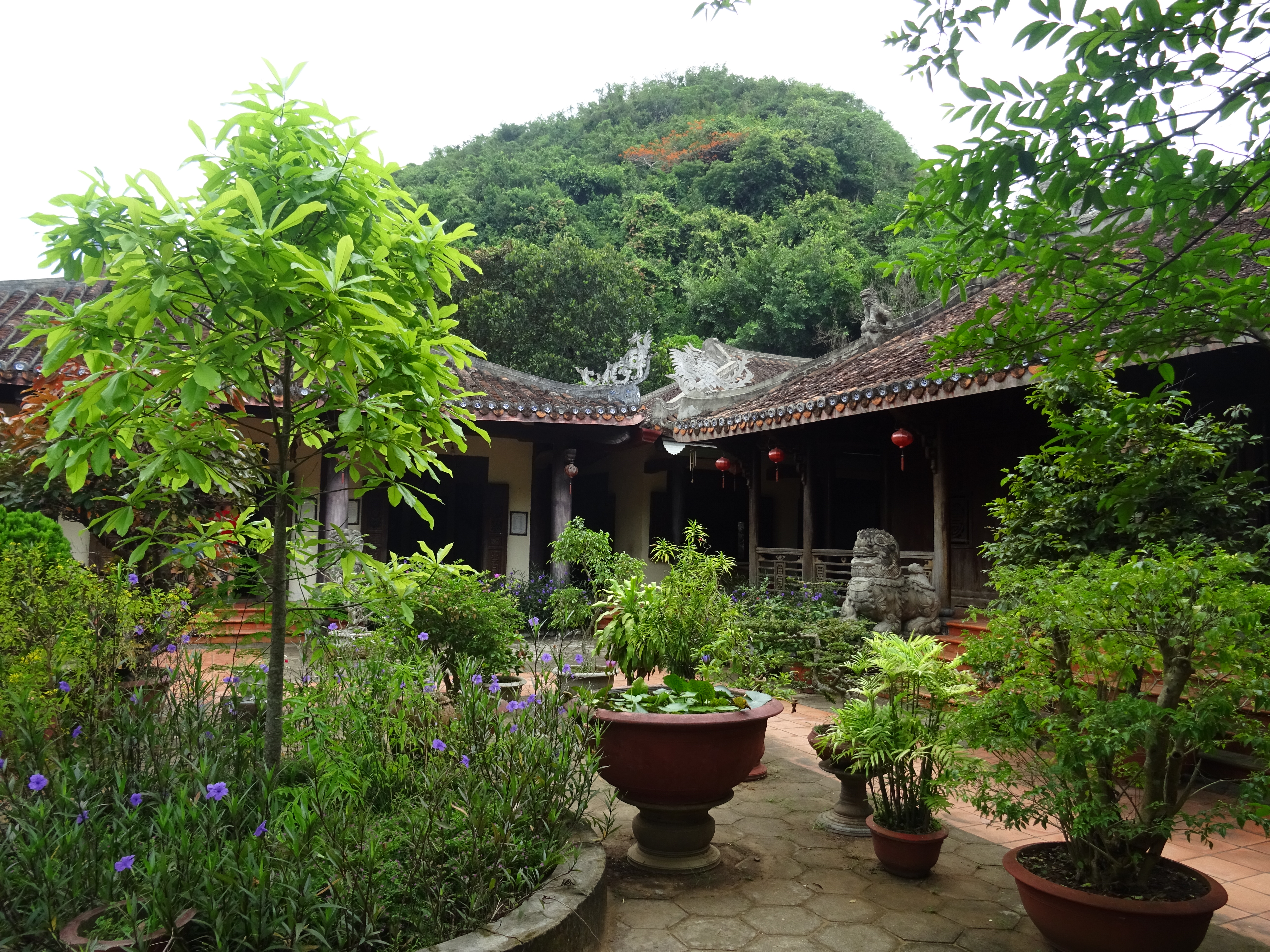
Purchase a return elevator ticket if you prefer not to descend 156 stone steps — especially energy-saving in hot weather. Remember to dress modestly (covered shoulders and knees) when entering pagoda areas.
How to visit & get there.
Getting to Marble Mountains
From Da Nang city centre: Approximately 9 km south — taxi costs around 80,000–120,000 VND, or take a rental motorbike south along Nguyen Tat Thanh/Truong Sa Road. Bus route 1 runs from the city centre to Ngu Hanh Son for 7,000 VND/person. Combined with Hoi An: Marble Mountains sits directly on the route from Da Nang to Hoi An (just 20 km further south) — very convenient to visit on the same day trip. Free parking at the main gate; public restrooms available.
Cave and Pagoda Visiting Tips
Opening hours: 7:00 am – 5:30 pm daily; arrive before 8 am to avoid crowds and midday heat. Purchase the entry ticket (40,000 VND/adult) and optional elevator ticket (15,000 VND/trip) at the main booth. Rubber-soled non-slip shoes are essential — many stone steps are steep and become slippery in the rainy season. Allow at least 2–3 hours to properly explore Thuy Son: ascend (by stairs or elevator), visit Huyen Khong, Tang Chon, and Am Phu caves and summit pagodas, then descend by the alternate route. Modest dress (covered shoulders and knees) is required when entering pagoda areas — some pagoda staff may decline entry for inappropriately dressed visitors. After the mountain, allow 30–60 extra minutes for the Non Nuoc craft village on the northern side of the mountain base.
Sources
- 1.Ngũ Hành Sơn — Di tích quốc gia đặc biệt
Cổng thông tin điện tử TP. Đà Nẵng · 2025-01-15
- 2.Marble Mountains (Ngu Hanh Son)
Lonely Planet · 2025-01-15
- 3.Ngũ Hành Sơn được xếp hạng di tích quốc gia đặc biệt
VnExpress · 2025-01-15