History & story.
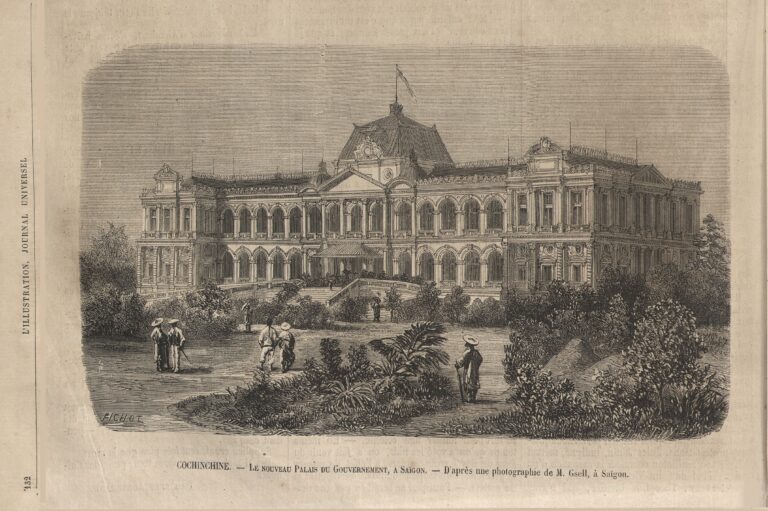
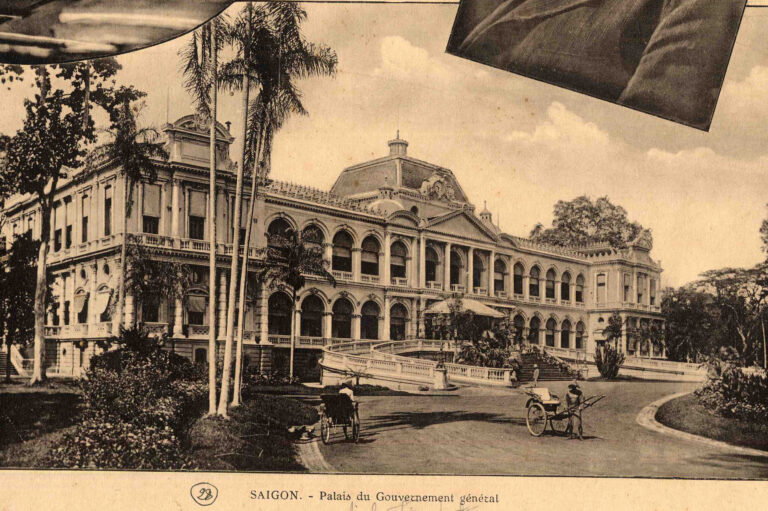
On February 23, 1868, Governor-General La Grandière laid the foundation stone of Norodom Palace — completed in 1871 as the residence and workplace of French Indochina's governors-general until 1945. On September 7, 1954, General Paul Ely transferred the palace to Prime Minister Ngô Đình Diệm, who renamed it Independence Palace and made it the presidential residence of the Republic of Vietnam. On the morning of February 27, 1962, pilots Nguyễn Văn Cử and Phạm Phú Quốc bombed the palace from two AD6 aircraft, severely damaging the left wing. Diệm ordered it completely demolished and commissioned architect Ngô Viết Thụ — the first Vietnamese to win the Prix de Rome (1955) — to design a new structure, begun July 1, 1962 and inaugurated October 31, 1966. President Ngô Đình Diệm never spent a single day in the palace — he was assassinated in the coup of November 2, 1963, three years before it was completed.
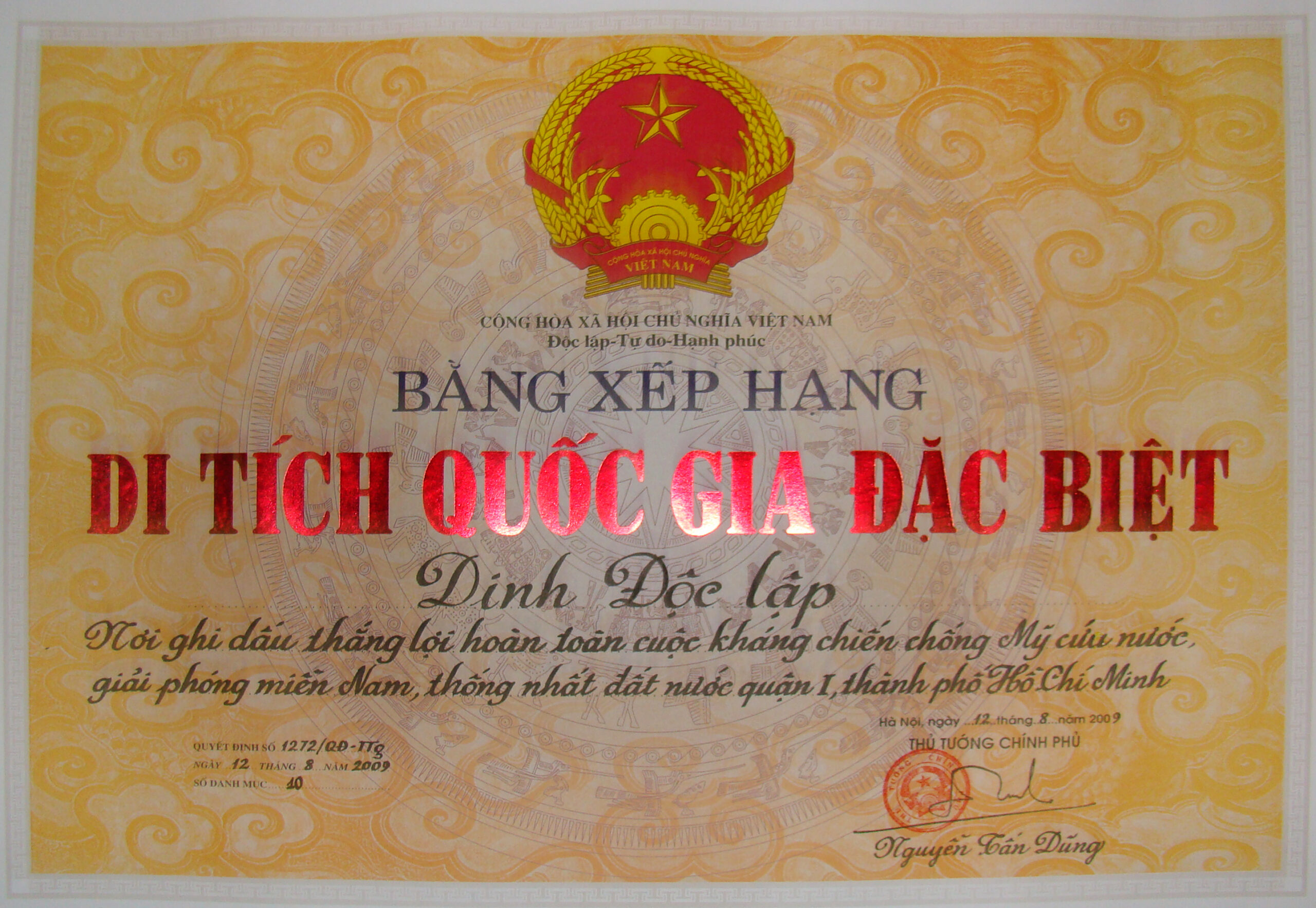
On April 8, 1975, undercover pilot Nguyễn Thành Trung — secretly operating within the RVNAF — flew an F-5E and bombed Independence Palace, one bomb striking the upper floors. Three weeks later, at 10:45 AM on April 30, tank 843 of Brigade 203 crashed through the side gate; tank 390 broke through the main entrance moments after. At 11:30 AM, Lieutenant Bùi Quang Thận raised the Liberation Front flag on the rooftop — a moment French photographer Françoise Demulder captured and published worldwide. In the basement, General Dương Văn Minh and the final cabinet were waiting to surrender unconditionally until 11:30 AM that same morning. On August 12, 2009, the palace was designated a Special National Heritage Site.
Ngô Viết Thụ's design is a system of architecturally encoded Eastern philosophy: the overall floor plan forms the character 吉 (cát — good fortune), the rooftop pavilion forms 口 (khẩu — education), the central axis with the flagpole creates 中 (trung — democratic governance), and the building facade encodes 興 (hưng — national prosperity). The T-shaped main building spans 4,500 m², stands 26 metres tall, with 95 rooms across 20,000 m² of total usable space. The second-floor stone lattice screens draw on the decorative 'ban khoa' bamboo blinds of Huế's imperial palaces. A 102-metre oval lawn, a semi-circular lotus pond and four tennis courts complete the 12-hectare estate. The largest space is the State Reception Hall on the second floor — where President Nguyễn Văn Thiệu received international heads of state, its embroidered furnishings and crystal chandeliers intact to this day.
Today all 95 rooms of Reunification Palace are preserved almost exactly as they stood in 1975: the cabinet room with its deep-red upholstered chairs and vintage telephones, the cinema, the teak-floored conversation lounge, the ballroom with crystal chandeliers, the underground command bunker with its telegraph machines and tactical maps — everything frozen in place as if the clocks stopped on April 30. More than 500,000 domestic and international visitors come each year — former soldiers confronting memory, Vietnamese children touching the history of their forebears for the first time, and Western visitors exploring the end of a war they only know from textbooks. The only space in the building that changed after 1975 is the rooftop pavilion — where architect Ngô Viết Thụ's chosen name 'Tứ Phương Vô Sự' (peace in all four directions) has finally, at last, been able to come true.
The entire floor plan of the Palace forms the character for 'Good Fortune' — the designer encoded a wish for peace into the architecture itself, yet history wrote its own script.
— Kiến trúc sư Ngô Viết Thụ, phát biểu khi khánh thành Dinh, 31/10/1966
Highlights not to miss.
The cabinet room is preserved in every detail: the long green baize table, deep red upholstered chairs, black 1960s-style telephones, and files still lying on the surface. This is where President Nguyễn Văn Thiệu chaired his final cabinet meetings before leaving Saigon on April 21, 1975. Sitting in the chairs here, visitors feel the strange distance between the grandeur of the furnishings and the tragedy unfolding just outside those doors. This space offers a material answer to the question: what does power look like at the moment of its collapse?
Built to withstand heavy bombs and artillery, the secret basement beneath the palace contains a cipher room, radio station, war strategy chamber with tactical maps, and internal telephone network — all preserved intact as they stood on April 30, 1975. Dim yellow light, cool damp air and deep silence create the sensation of standing underground inside a just-ended war. This is the most haunting section of the entire palace, where the contrast between modern military technology and the elegant civilian furnishings above creates an almost surreal effect.
The rooftop holds the helipad where the chaotic final evacuations took place on the afternoon and morning of April 29–30, 1975. Standing here and looking out across central Saigon, you can see every building the Liberation Army commanders surveyed as they drove in on the morning of April 30. Architect Ngô Viết Thụ named this pavilion 'Tứ Phương Vô Sự' — peace in all four directions — a name that proved impossible to fulfill.
The upper state rooms are decorated with Vietnamese lacquer paintings and embroidered silk — a deliberate aesthetic choice by Ngô Viết Thụ to assert national cultural identity within an internationally styled building. Ornately carved furniture sets, crystal chandeliers and hand-woven carpets furnished the ceremonial reception spaces where President Thiệu hosted foreign heads of state. The remarkable fact is that all this opulent furnishing remains entirely intact — not a single detail was removed or replaced after April 30, 1975.
Arrive before 8:00 AM to beat the tour groups. Head straight down to the basement bunker when you enter — the silence and dim yellow lighting create an experience that is lost once crowds arrive later in the morning.
How to visit & get there.
Getting There
The palace is in central District 1 (135 Nam Ky Khoi Nghia), 10 minutes on foot from the Central Post Office and Notre-Dame Cathedral. Grab or bus (multiple routes pass Nguyen Du / Nam Ky Khoi Nghia) are most convenient. The palace has its own car park for motorbikes and cars inside the grounds — free when you purchase entry.
Must-See Inside
Allow at least 2 hours covering all floors, the bunker and the rooftop. Go to the basement first — the dark silence with wartime telegraph equipment creates the strongest impression before crowds arrive. Volunteer guides are usually present in mornings — ask at reception to join for free. Wear flat-soled shoes for the staircase climbs. The State Reception Hall on the second floor and the rooftop 'Four Directions of Peace' pavilion are the best photography spots.
Nearby
Central Post Office and Notre-Dame Cathedral are 10 minutes on foot to the northeast. The Fine Arts Museum on Pho Duc Chinh Street is 5 minutes by vehicle.
Sources
- 1.History of Independence Palace
Ban Quản lý Di tích Dinh Độc Lập · 2026-06-06
- 2.Dinh Độc Lập và những biến cố lịch sử ở Sài Gòn
VnExpress · 2026-06-06
- 3.Ngày 8/4/1975: Máy bay ta ném bom Dinh Độc Lập
Báo Nhân Dân · 2026-06-06