History & story.
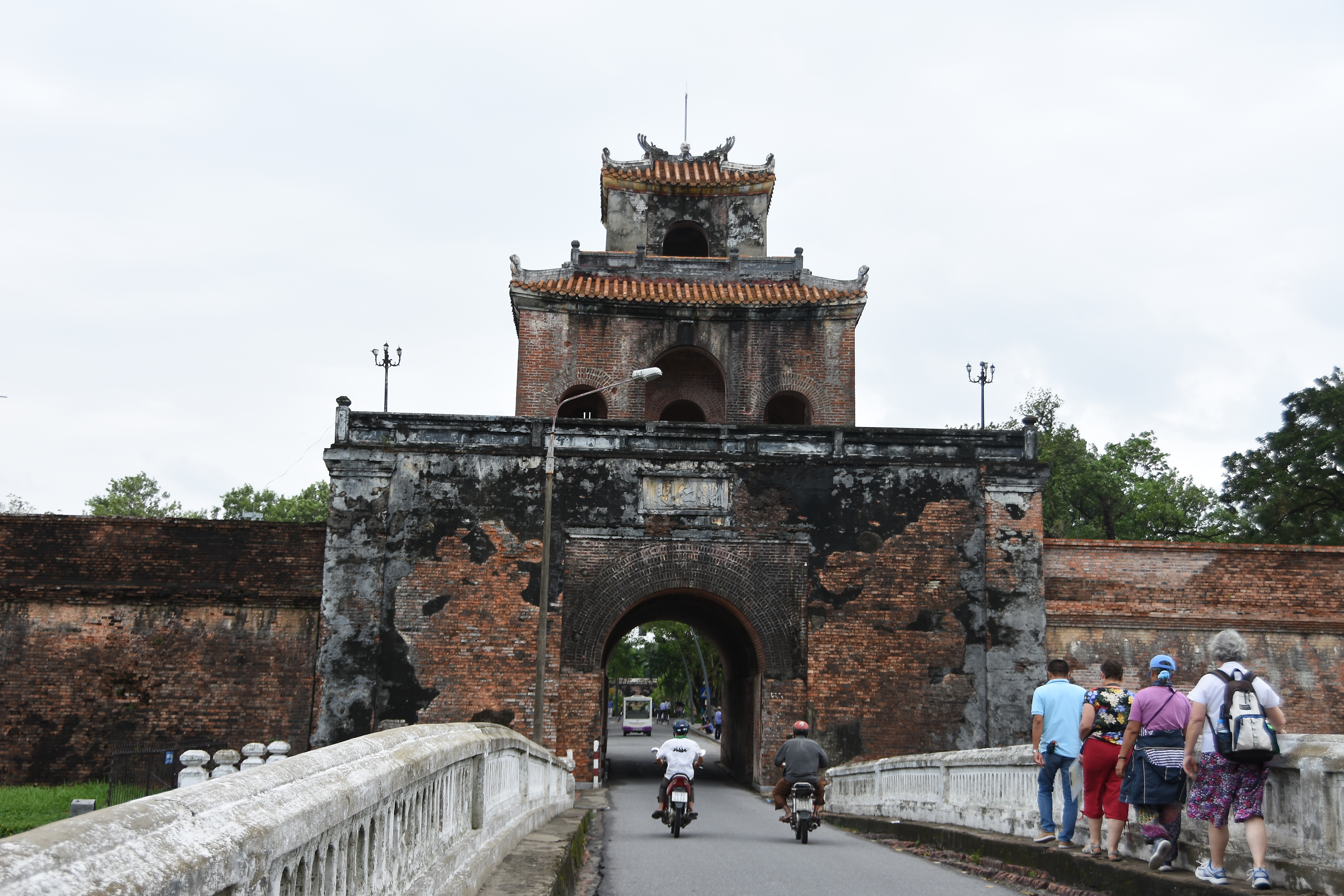
Emperor Gia Long — the man who unified Vietnam after decades of civil war — chose neither Hanoi nor Saigon for his capital but planted his dynasty at Hue in 1802, on a site surveyed for perfect feng shui: Ngu Binh Mountain blocking to the south like a natural windbreak, the Perfume River curving before it like a spirit mirror. Construction of the Imperial Enclosure began in 1805 and continued for over two decades — walls 6 meters high and 20 meters thick, designed on French Vauban fortress principles but laid out internally on the model of Beijing's Forbidden City, yet deeply Vietnamized. Each Bat Trang brick, each red ironwood column carved with dragons, each glazed yellow tile was selected and transported from across the country on imperial orders. In 1993 UNESCO inscribed the Complex of Hue Monuments as a World Heritage Site — recognition for a compound where 20th-century warfare destroyed nearly half the original structures but which retains enough to captivate the world. Ngo Mon with its five arched gateways and the five-phoenix belvedere above is the iconic image printed on the 50,000-dong note — and the gate before which Emperor Bao Dai abdicated in 1945 before a crowd of tens of thousands.
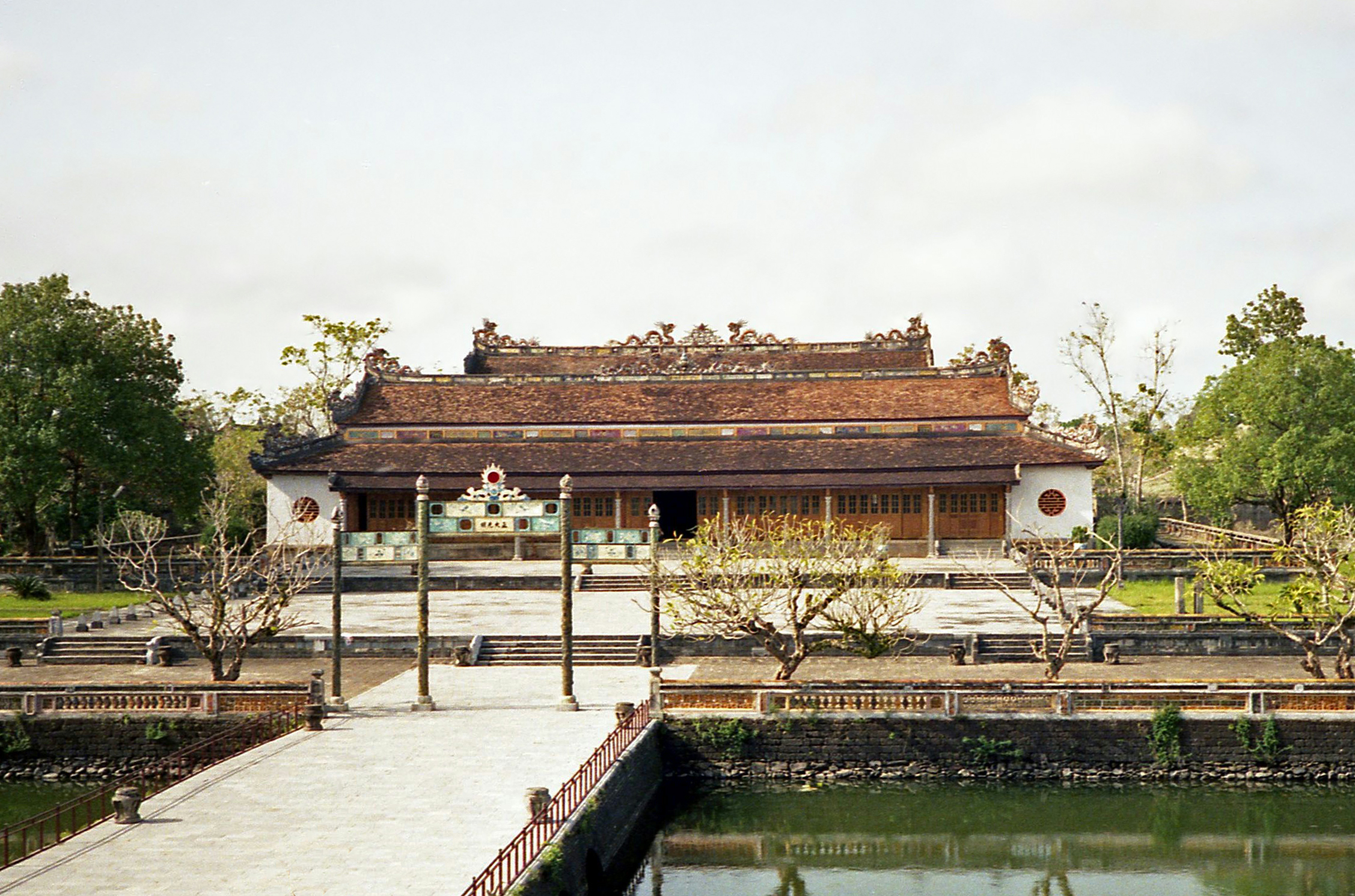
The political heart of the Citadel is Thai Hoa Palace — where each Nguyen emperor held court, received foreign envoys, and conducted state ceremonies before over a hundred officials prostrating in the courtyard. Eighty red-painted ironwood columns carved with gold dragons support the yellow-glazed tile roof, while the ceiling is covered with hundreds of lacquered and gilded paintings. The original throne remains in situ — one of the very few Nguyen royal artefacts to have survived in place through all the upheavals of the 20th century. Behind Thai Hoa is the Forbidden Purple City with over 50 original structures, 70% destroyed by fire in 1947 and the 1968 Tet Offensive. Kien Trung Palace — where Emperor Bao Dai and Empress Nam Phuong lived — was fully restored in 2024, complete with unique Art Deco interiors that speak to the last years of colonial Hue. Co Ha Garden and Thieu Phuong Garden within the grounds remain strangely tranquil sanctuaries of lotus ponds, artificial rockeries, and ancient trees in the heart of the majestic complex.
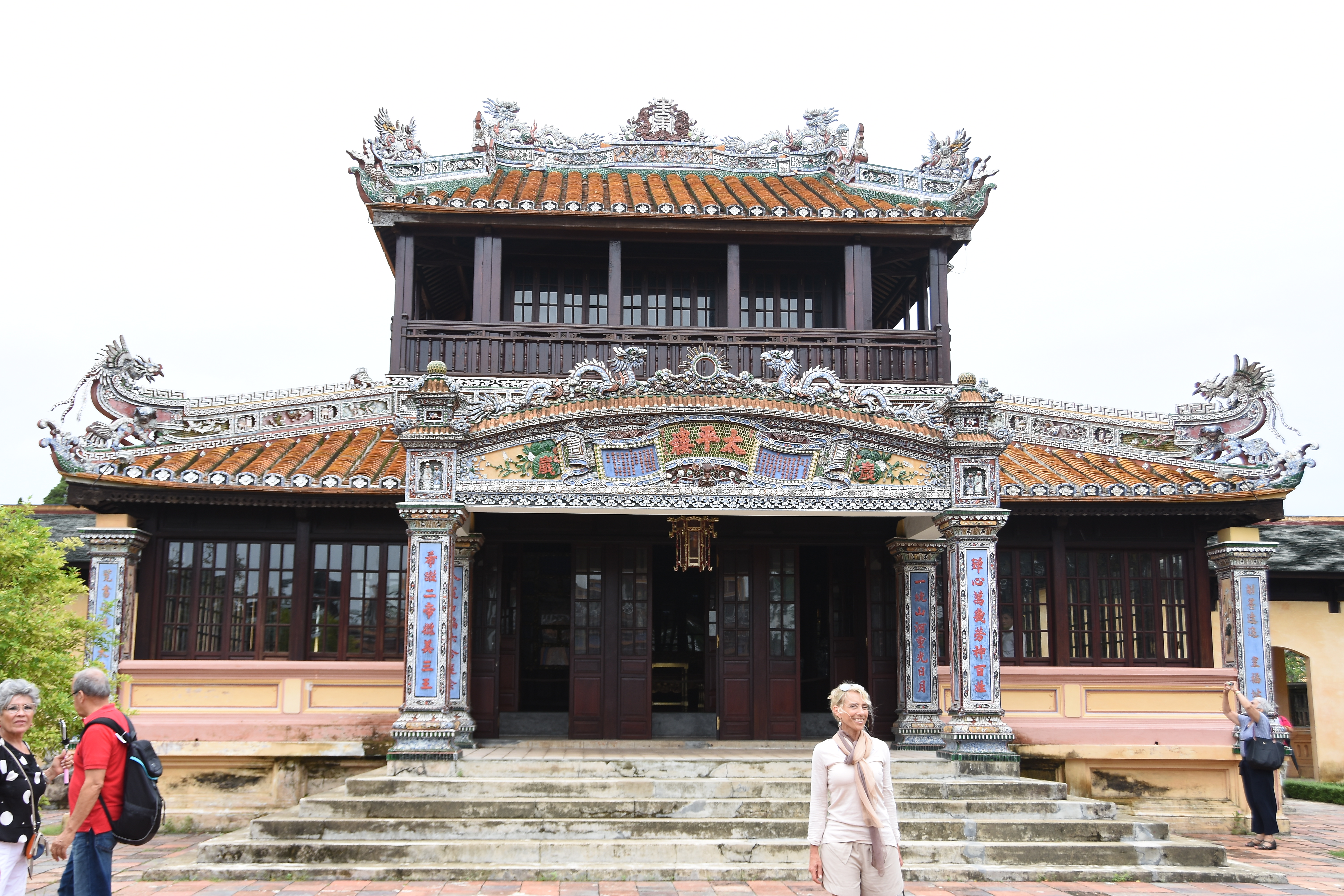
Before Hien Lam Pavilion — the tallest structure in the Citadel, built 1821 — the nine dynastic bronze urns cast between 1835 and 1837 stand in a row like enormous sentinels. Each urn stands 2.5 meters tall and weighs 1.9–2.6 tons, embossed with 17 characteristic images of Vietnam: mountains, rivers, trees, weapons, and farming tools. The Nine Urns are not merely ritual objects but a sovereignty declaration of the Nguyen dynasty over every inch of Vietnamese territory, recognized as National Treasures in 2012. In 2024 UNESCO additionally recognized the System of Royal Architecture Poetry and Literature carved on Hue's palace structures as a World Documentary Heritage — 2,700 poems and inscriptions carved into the walls, columns, and roofs of this very Citadel. It is an encyclopaedic monument — simultaneously architecture, literature, and living history — and nowhere else in Vietnam is that combination achieved.
Every two years the Hue Festival transforms the Imperial Citadel into Vietnam's largest open-air stage: nha nhac court music (UNESCO intangible heritage since 2003) resonates inside Thai Hoa Palace, international dance companies perform under Ngo Mon's five arches, and tens of thousands of lanterns illuminate the moat surrounding the citadel walls. The restoration program extending to 2030 continually reveals new surprises — 19th-century drainage systems still functioning underground, hidden chambers beneath the Forbidden Purple City still being excavated. This is not a place of pure tourism — each step on Bat Trang brick is a step into a space where history and the present are still negotiating with each other. Early morning light on the yellow roof tiles, or Hue's fine rain drifting across the wide ceremonial courtyard — each visit reveals a different Citadel.
You can understand a people by what they build at the height of their power — and the Hue Imperial Citadel is the finest Vietnamese answer to that question.
Trung tâm Bảo tồn Di tích Cố đô Huế
Highlights not to miss.
Built in 1833 under Emperor Minh Mang, Ngo Mon has five arched passageways encoding the social hierarchy: the central gate for the emperor, adjacent gates for civil and military mandarins, outer gates for elephants and horses. The five-phoenix belvedere above, with 100 wooden columns and green-and-yellow glazed roof tiles, is where the emperor appeared before subjects on major occasions — and where Emperor Bao Dai abdicated on 25 August 1945 before a crowd of tens of thousands, ending 143 years of Nguyen rule. The image of Ngo Mon printed on the 50,000-dong note is one of the most frequently seen symbols in Vietnam.
The Citadel's most ceremonially significant palace, Thai Hoa was built in 1805 and renovated in 1833, serving as the audience hall where each Nguyen emperor received foreign ambassadors and conducted state ceremonies before the assembled court. Eighty red-painted ironwood columns carved with dragons support the yellow-glazed tile roof, while the ceiling is covered with hundreds of lacquered and gilded paintings depicting dragons, phoenixes, and Chinese-character poetry. The original throne remains in situ — one of the very few Nguyen royal artefacts to have survived in its original position through all the upheavals of the 20th century.
The innermost precinct of the palace complex — reserved for the emperor, his consorts, and trusted personal staff — the Forbidden Purple City once contained over 50 palaces, pavilions, and gardens across 28 hectares. Most burned in the fighting of 1947 and 1968, leaving moss-covered stone foundations and bare columns standing in overgrown gardens — a haunting landscape utterly unlike the grandeur of Thai Hoa Palace in front. Kien Trung Palace — the most modern of the imperial residences, where Emperor Bao Dai and Empress Nam Phuong lived — was fully restored in 2024, complete with its concrete roof and unique Art Deco bathroom interiors.
Hien Lam Pavilion — the tallest structure in the Imperial Enclosure, built 1821 — enshrines deceased emperors and royal kinsmen. Before it stand nine massive bronze dynastic urns cast between 1835 and 1837, each 2.5 meters tall and weighing 1.9–2.6 tons, bearing the name of a Nguyen emperor from Gia Long to Thieu Tri and embossed with 17 characteristic images of Vietnam. The Nine Urns are not merely historical treasures but a sovereignty statement — each engraved image represents a territory, a plant species, or a river that the Nguyen dynasty claimed to govern. In 2012 they were formally declared National Treasures of Vietnam.
Arrive before 8 am to beat the crowds and midday heat — morning light also produces the most beautiful photographs of the glazed roof tiles and palace courtyards.
How to visit & get there.
Getting There and Tickets
The Citadel lies 1–2 km from central Hue, easily reached by bicycle, cyclo, or taxi. The main entrance is Ngo Mon Gate on 23 Thang 8 Street. Adult tickets are VND 200,000; children under 16 pay VND 40,000 — book online at `hueworldheritage.org.vn` to skip queues during peak season (April–August). Opening hours 7:00–17:30 (until 18:00 in summer). Arrive before 8 am to beat crowds and get the best morning light for photography.
Dress Code and Visit Tips
Wear modest, respectful clothing — no shorts or sleeveless tops inside shrine halls or the Forbidden Purple City. Comfortable flat shoes are essential given the 520-hectare grounds require considerable walking. Allow at least 2.5–3 hours for a thorough circuit. Licensed guides speaking Vietnamese and English are available for hire at the entrance gate, or download the official audio guide app for self-paced commentary on each structure.
Sources
- 1.Đại Nội Huế — Trung tâm Bảo tồn Di tích Cố đô Huế
Trung tâm Bảo tồn Di tích Cố đô Huế · 2025-03-10
- 2.Complex of Hue Monuments — UNESCO World Heritage List
UNESCO · 2025-03-10
- 3.Đại Nội Huế: Lịch sử và kiến trúc hoàng cung
VnExpress · 2025-03-15