History & story.
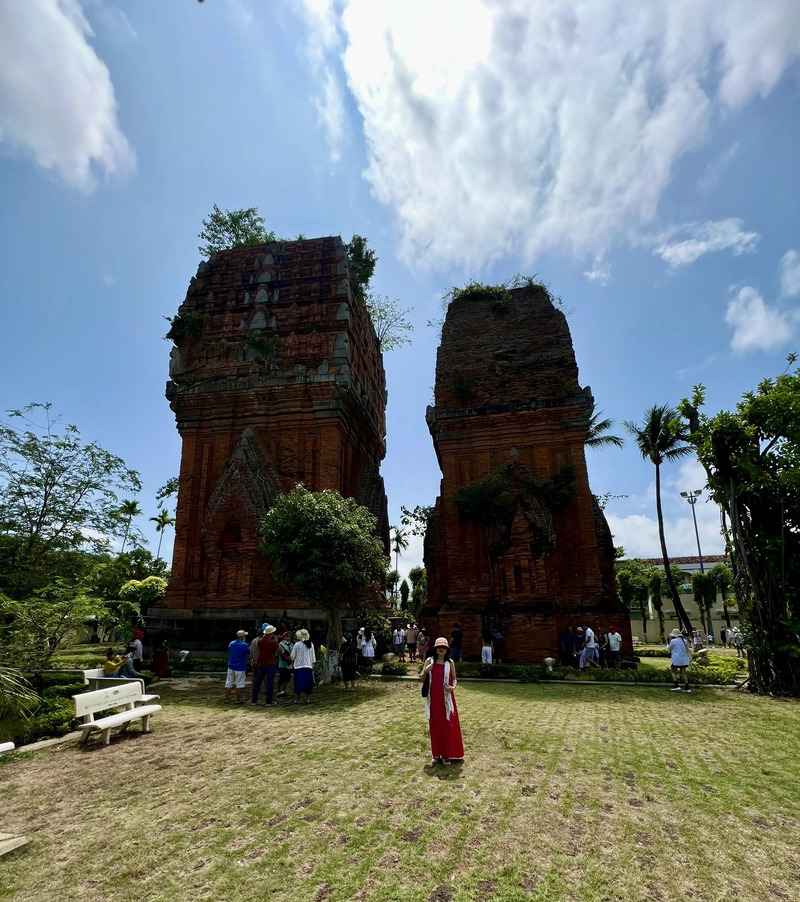
Tháp Đôi was built in the late 12th century during the Vijaya period — the capital phase of the Cham Pa kingdom centered on present-day Binh Dinh. The two towers were dedicated to the Hindu deities Shiva and Vishnu, forming part of the dense network of sanctuaries the Cham Pa built along the coastal strip from Quang Nam to Binh Thuan. Unlike other Binh Dinh tower clusters placed on hilltops or in open paddy fields, Tháp Đôi stands in the heart of modern Quy Nhon city — beside Doi Lake on the busy Tran Hung Dao boulevard. This location makes it one of Southeast Asia's rarest examples of an ancient religious monument surviving in place amid an actively developing urban environment. The two towers stand 20 metres (north tower) and 18 metres (south tower) tall, built entirely from fired brick without mortar using the signature Cham Pa interlocking technique.
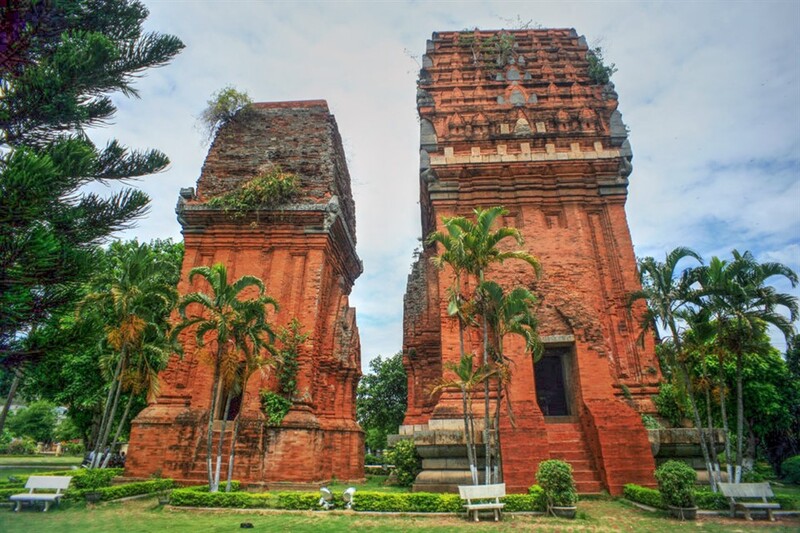
The architectural style of Tháp Đôi carries distinctive features rarely seen in the Cham tower system: rather than the uniformly tapering tiers of traditional Cham design, these two towers have unusually elongated spires showing clear influence from 12th-century Khmer Angkor style. Archaeologists view this as evidence of architectural exchange between Cham Pa and the Khmer Empire during a period when both were at the peak of their power. Brick surfaces are carved with lotus-petal motifs, open-mouthed Kala demons and Apsara dancers — though many details have been worn by centuries of weather. The north tower is larger and retains more intact bas-reliefs; the south tower is smaller and more damaged from proximity to vehicle traffic. A major 1991 restoration project reinforced the foundations and cleaned the brick surfaces without adding any new material to the original structure.
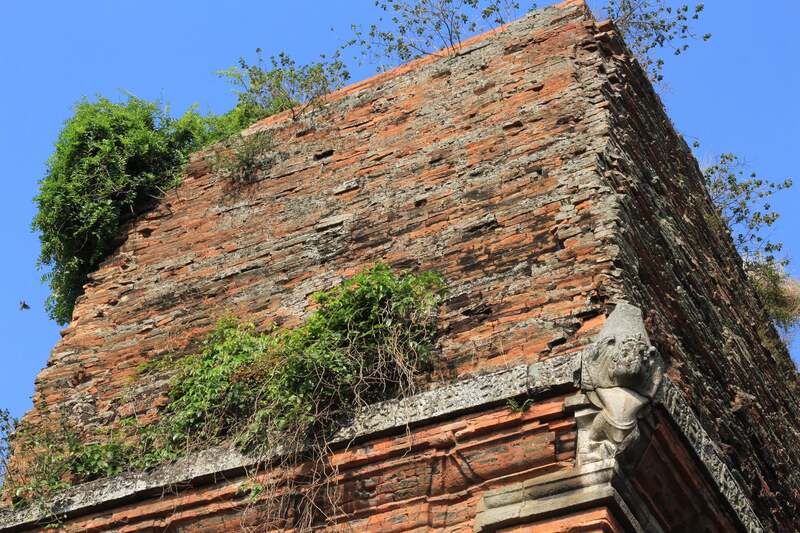
Throughout the Đại Việt period controlling Binh Dinh after 1471, Tháp Đôi was not destroyed like many other Cham structures — perhaps because its position within the town made it too visible and too proximate to be forgotten or deliberately erased. Through the Lê dynasty, Nguyễn dynasty, and French colonial period, the towers stood while the city grew around them. 20th-century Quy Nhon residents grew up with Tháp Đôi as an urban landmark — the towers by the lake, near the market, close to the bus station. The surrounding area, once a swamp, became an urban drainage lake; the embankment was stone-paved and shaded with trees, transforming the space around the towers into a late-afternoon gathering point for locals.
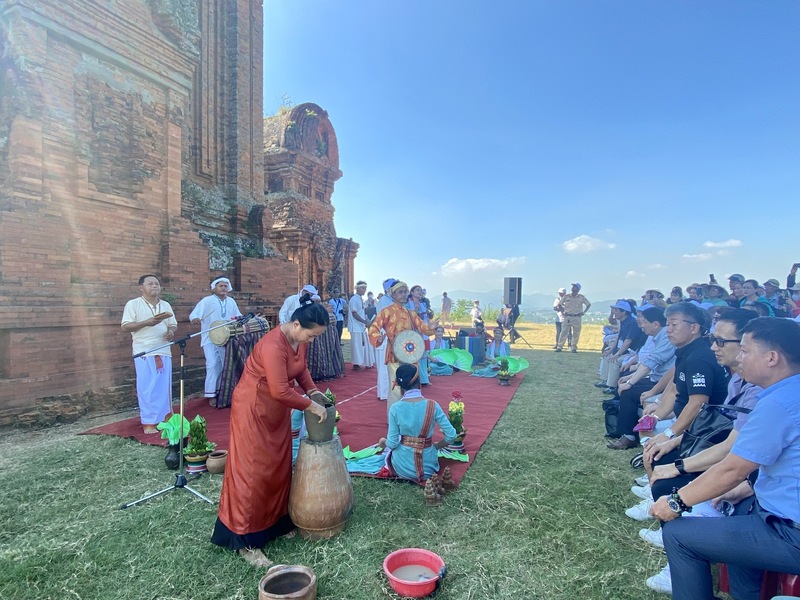
Today Tháp Đôi is designated a National Heritage Site and is one of two visual symbols of Quy Nhon city alongside its famous beach. On weekend evenings, the Doi Lake area becomes a vibrant community space: people exercising, children running, elderly residents sitting in the cool air — while the two towers stand motionless behind them as silent witnesses to 800 years of change. Yellow floodlights illuminating the red brick surface at night create a distinctive scene found nowhere else in Binh Dinh province.
Tháp Đôi is rare proof that sometimes history survives not because it was carefully preserved, but because it stood too squarely in the middle of daily life to be forgotten.
— Nguyễn Thanh Quang, nhà nghiên cứu di sản Chăm Pa, Bình Định
Highlights not to miss.
The north tower is the larger of the two and retains the most intact sculptural detail, with bas-reliefs of Kala demons, Apsara dancers and lotus motifs carved into the red brick surface. The tower entrance faces east following Hindu tradition — toward the rising sun, the direction of divine presence. The interior chamber is dark and narrow, empty now but still carrying the sense of the original sacred space the Cham Pa created.
Doi Lake immediately beside the towers is Quy Nhon residents' natural gathering point every early morning and evening. The lake surface reflects the image of both towers against the sky — creating Binh Dinh's most distinctive photography angle. The embankment is lined with coconut palms and stone benches where locals exercise, drink coffee and meet — a rare urban space where ancient heritage and modern daily life genuinely share the same ground.
The spires of Tháp Đôi are unusually elongated compared to other Cham towers in Binh Dinh — a clear trace of 12th-century Khmer Angkor architectural influence, from a period when Cham Pa and the Khmer Empire were simultaneously rivals and cultural exchangers. This is why Tháp Đôi attracts particular attention from Southeast Asian architectural researchers as a link between two civilisations. This hybrid style does not appear in any other Cham tower cluster in Binh Dinh province.
Buy a coconut or sugar cane juice from the carts around Doi Lake before entering — there are no food or drink vendors inside the tower grounds. Wear flat shoes as the old brick paving around the towers is uneven.
How to visit & get there.
Getting to Tháp Đôi
The towers are in central Quy Nhon on Tran Hung Dao Street — 10 minutes on foot from Quy Nhon beach. From Quy Nhon bus station you can walk or take a Be/Grab motorbike taxi (about 5 minutes). No private vehicle needed — the towers are in a fully urban, easily accessible location.
When to Visit
Early morning 6:30–8:00 is the best time: angled golden light falls on the red brick, Doi Lake is mirror-calm and uncrowded. Late afternoon 4:30–5:30 PM is equally beautiful as the sun drops low. Avoid 10:00 AM–3:00 PM — no shade and intense heat. The towers are lit with yellow floodlights at night — viewing from outside the fence after 7 PM is also a worthwhile and free experience.
Sources
- 1.Tháp Đôi — Di tích Chăm Pa tại Quy Nhơn
Tổng cục Du lịch Việt Nam · 2026-06-26
- 2.Tháp Đôi Quy Nhơn — dấu ấn Chăm Pa giữa lòng thành phố
VnExpress · 2026-06-26