History & story.
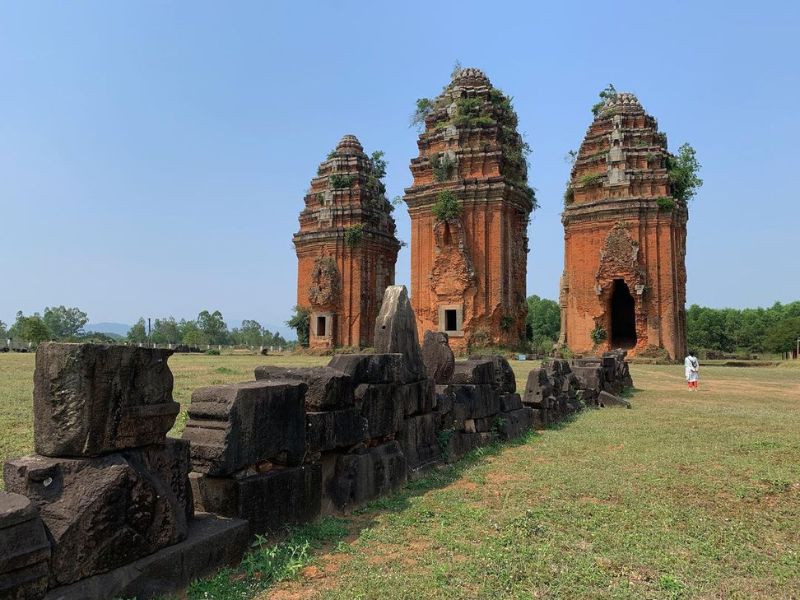
Dương Long towers were built in the late 12th century under Cham Pa's Vijaya dynasty — at the same time Angkor Wat was being completed in Cambodia and the Hindu empires of Southeast Asia were at their peak. The three towers take their name from the Cham phrase Yang Long — meaning 'Ivory Tower' or 'Great God Tower' — and were dedicated to the Hindu trinity of Brahma, Vishnu and Shiva. The three towers stand on a north-south axis: the central tower at 36 metres, the north tower at 27 metres and the south tower at 24 metres. All three are built entirely from dark red fired brick without mortar — the signature Cham Pa technique whose bonding secret scientists have still not fully decoded.
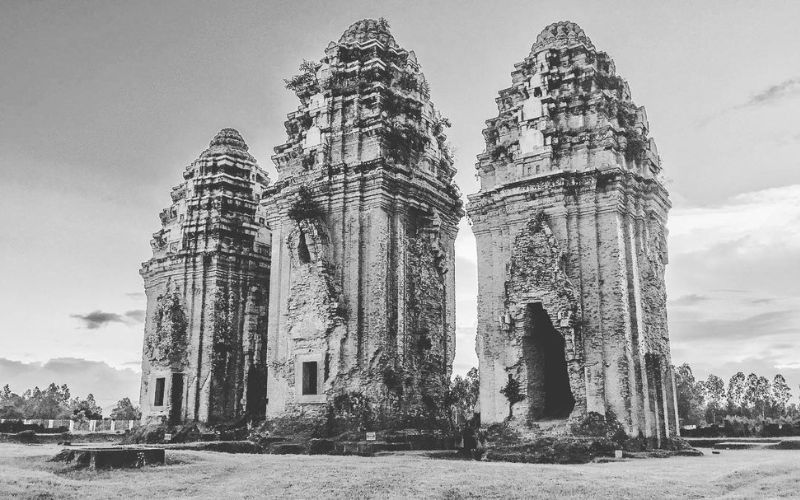
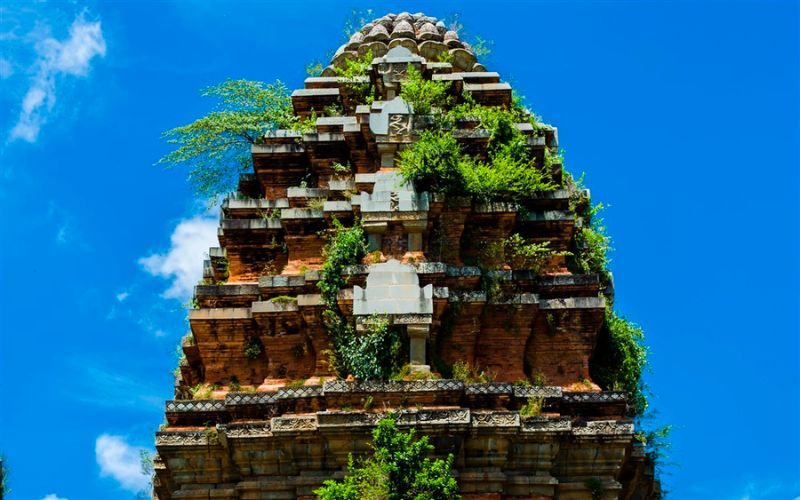
What makes Dương Long exceptional within the entire Cham tower system of Vietnam is not only its height but the unusually high quality of its sculpture: four-faced Brahma figures, multi-armed Shiva, Apsara dancers and Makara sea-dragons are carved with a precision surpassing most other surviving Cham towers in Vietnam. The tower crowns are notably capped with sandstone blocks — a material distinct from the brick body — creating the characteristic red-and-gold colour contrast visible from a distance. This also provides evidence that Cham Pa used multiple construction materials within a single monument.
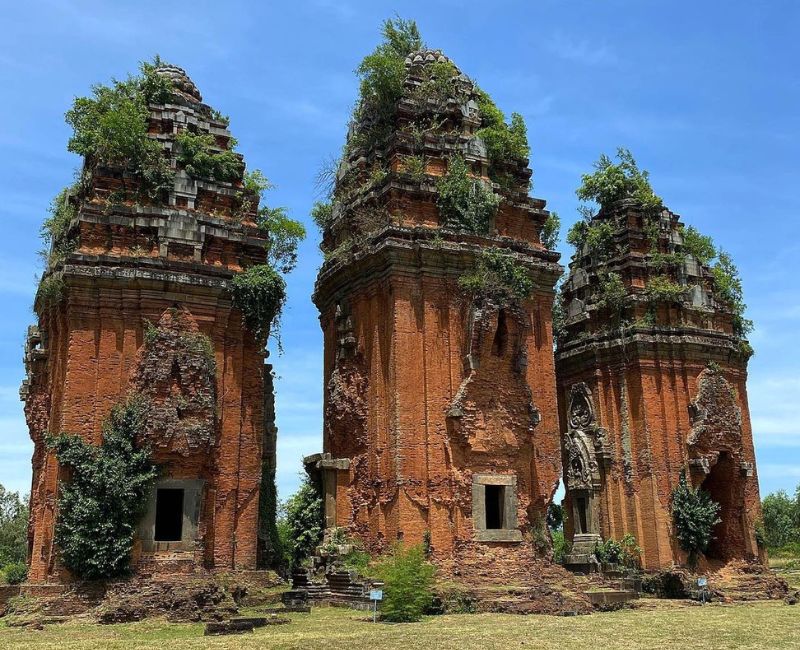
Dương Long towers stand in the heart of Tay Son district — the land that three centuries later would be the starting point of the Tây Sơn uprising. During the 1770s and 1780s, as the Tây Sơn brothers assembled their forces in Tay Son, the three towers still stood as geographic landmarks for marching armies. After the Cham Pa dynasty fell in 1471, the towers ceased to serve as places of worship but were not demolished — Vietnamese settlers around them treated the three towers as directional landmarks on the flat Tay Son plain.
Dương Long is now designated a Special National Heritage Site. The surrounding area has been cleared and developed into a fenced visitor site with a paved path up the hill. Yet the atmosphere remains distinctively quiet — because Dương Long is about 45km from Quy Nhon city and lies off every standard tourist circuit. Most visitors come combining it with a trip to Quang Trung Museum and Ham Ho gorge on the same day. That low footfall is the ideal condition to sit in the sparse shade and absorb the true scale of this 800-year-old monument.
The Cham did not build Dương Long to be looked up at — they built it for the gods to look down from. At 36 metres with no elevator and no modern scaffolding, what does that mean?
— Trần Kỳ Phương, nhà nghiên cứu kiến trúc Chăm Pa
Highlights not to miss.
The central 36-metre tower is the focal point of the entire complex, with its dark red brick body and golden sandstone crown creating the characteristic colour contrast. The entrance faces east, and inside the narrow, dark chamber the original sacred atmosphere of a Hindu sanctuary is preserved. Standing at the base of the tower, visitors truly feel the extraordinary scale of a structure built by hand without machinery in the 12th century.
The Apsara dancers and Makara sea-dragons on Dương Long's tower bodies are considered among the most refined in the entire Cham Pa heritage of Vietnam. The Apsaras here have soft outlines with the characteristic Vijaya-style smile, while the Makara — the Hindu sea-dragon — opens its mouth to emit large flowing decorative spirals. Many details have been worn by weather but most remain clear enough to recognise.
The towers sit on a low hill, and from the surrounding grounds you can survey the Tay Son rice paddies stretching toward the mountains. In the green rice season (April–June) or golden harvest season (July–September), the panorama of farmland with three red towers standing against the green or gold backdrop is one of the finest rural landscapes on the central Vietnam coast.
Bring binoculars if you have them — many sculptural details on the upper section of the 36-metre central tower are hard to see clearly from ground level with the naked eye. Pay attention to the golden sandstone crown at the top — this material distinction is something most visitors overlook but is technically fascinating from an architectural standpoint.
How to visit & get there.
Getting to Dương Long
The towers are about 45km northwest of Quy Nhon, via National Highway 19 through Binh Khe then into Tay Son District. Renting a motorbike or car in Quy Nhon is the best approach — there is no direct bus service from the centre. Combine on the same day with Quang Trung Museum (8km away) and Ham Ho gorge (15km away) to maximise the long journey.
On-site Visit
Allow 1–1.5 hours to walk around all three towers, read the information boards and examine the sculptural detail on the tower bodies. Bring adequate water — there are no food or drink vendors in the area. Wear closed shoes for climbing the small hillside around the towers. Early morning before 9 AM is ideal: angled light brings out the red brick texture and sculptural relief more vividly.
Sources
- 1.Tháp Dương Long — cụm tháp Chăm cao nhất Việt Nam
Tạp chí Tổ Quốc · 2026-06-26
- 2.Tháp Dương Long — di sản Chăm Pa tại Bình Định
Tổng cục Du lịch Việt Nam · 2026-06-26