History & story.
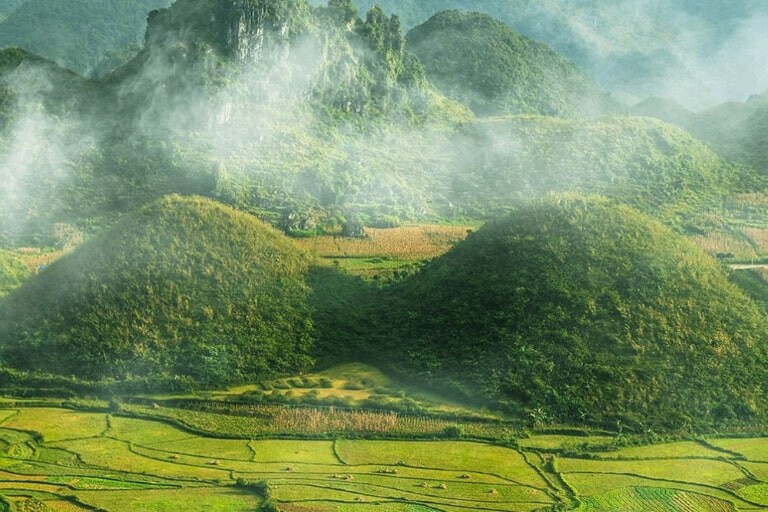
The Quan Ba Twin Mountains are two hemispherical hills rising side by side from the floor of the Tam Son valley in Quan Ba district — the first gateway into the Dong Van Karst Plateau, about 40 km from Ha Giang city. The two peaks stand at nearly equal heights of approximately 1,000–1,100 metres, rising from the valley floor so abruptly and symmetrically that nature appears to have used a mould. Local H'Mong people call them 'Núi Cô Tiên' — the Maiden Fairy Mountains — after an ancient legend. In 2009, the Twin Mountains and Quan Ba Heaven's Gate were designated a National Scenic Landmark.
H'Mong legend tells that long ago a celestial fairy fell in love with a young man in the Tam Son valley. The two lived happily and had a child together. But the Jade Emperor discovered the union and ordered the fairy to return to heaven. Before leaving, she placed her breasts upon the valley floor as a source of nourishment for her child and the villagers forever — and that is the origin of the Twin Mountains. This story is passed down orally through H'Mong generations in Quan Ba and remains an important part of the community's cultural identity.

Viewed from the Heaven's Gate overlook on Quan Ba Pass, the Twin Mountains nestle perfectly in the Tam Son valley, surrounded by terraced rice fields. In rice harvest season (September–October), golden fields contrast with the deep green of the two peaks to create a vivid colour palette rarely seen. In spring, peach and plum blossoms bloom pink and white around the base. In winter, mist sometimes hangs between the two summits like a veil. Every hour of the day, shifting light gives the Twin Mountains an entirely new appearance.
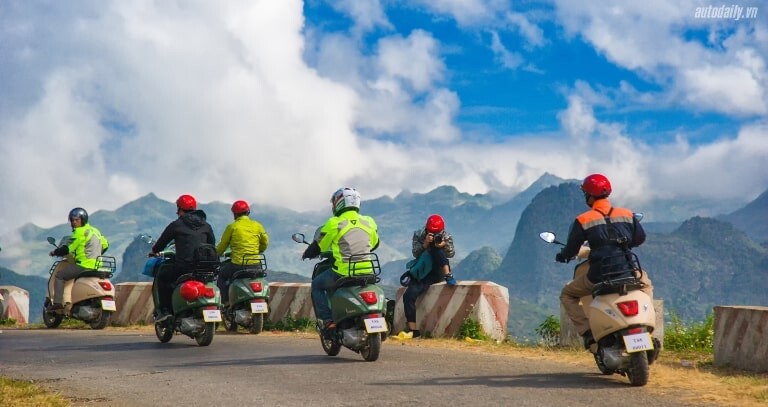
Today, the Quan Ba Twin Mountains are the first unmissable stop on the Ha Giang Loop. Visitors typically pause at the Heaven's Gate viewpoint on the pass to photograph the Twin Mountains from above before descending into the Tam Son valley. In the valley, H'Mong homestays allow guests to stay overnight and catch sunrise — the moment when morning mist slowly dissolves and the Twin Mountains emerge in the first light of day, which many photographers call the most beautiful sight in Ha Giang.
Each season the Twin Mountains wear a different colour — rice green, autumn gold, bare brown, canola pink — but their sacred silhouette has never changed.
VnExpress Du Lịch, 2016
Highlights not to miss.
The Heaven's Gate viewpoint sits at the top of Quan Ba Pass at approximately 1,500 metres, overlooking the entire Tam Son valley with the Twin Mountains at its centre. This is the most comprehensive vantage point for photographing the Twin Mountains and earns its name — from here onwards, the karst plateau country stretches all the way to the border. A large car park and local stalls selling souvenirs and light snacks are available.
Descending into the Tam Son valley below the Twin Mountains, visitors find a quiet small town inhabited by H'Mong, Dao, and Tay communities. Terraced fields around the mountain base are farmed year-round — wet rice in summer, vegetables in winter. Several local families have opened homestays that allow guests to spend the night in natural surroundings just a few hundred metres from the Twin Mountains.
One of Ha Giang's most beautiful sunrises is from the Heaven's Gate viewpoint looking down into the misty Tam Son valley. Around 5:30–6:30 AM, the sun rises behind the eastern ridgeline and casts its first golden rays on the Twin Mountains while the valley below remains submerged in morning mist. To catch this scene, visitors need to stay overnight in Quan Ba town or a valley homestay.
The best angle for photographing the Twin Mountains is not from Heaven's Gate on the pass (too high, making the mountains appear small) but from the terraced fields along the road in Tam Son valley, approximately 100–200 metres south of the two peaks. Morning light (6:30–8:00 AM) from the east casts beautiful shadows on the rounded hills.
How to visit & get there.
Getting There From Ha Giang city, take National Highway 4C about **40 km north** — Quan Ba Pass and Heaven's Gate are the first stop on the Ha Giang Loop. **Drive time**: 1–1.5 hours from Ha Giang city.
Planning Your Visit **Stay overnight** in Quan Ba town or a Tam Son valley homestay to catch sunrise the next morning. **Avoid midday arrivals** — harsh noon light flattens the scene and clouds typically gather to obscure the Twin Mountains.
Sources
- 1.Những câu chuyện huyền thoại quanh núi Đôi Quản Bạ
VnExpress · 2026-06-16
- 2.Nỗi buồn núi Đôi Quản Bạ
Tuổi Trẻ · 2026-06-16