History & story.
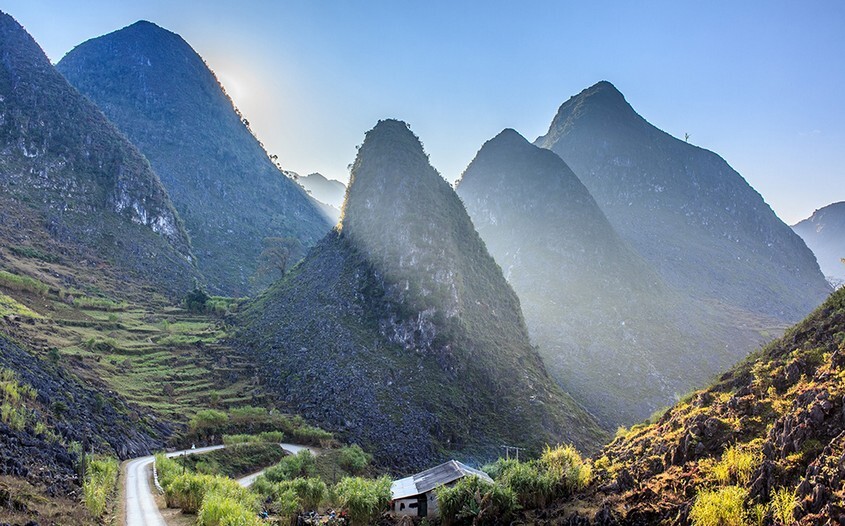
The Dong Van Karst Plateau spans 2,356 square kilometres across four districts — Quan Ba, Yen Minh, Dong Van, and Meo Vac — in Ha Giang province. On 3 October 2010, UNESCO officially recognised it as a Global Geopark: Vietnam's first and Southeast Asia's second, after Malaysia's Langkawi. The 550-million-year-old limestone preserves traces of two of Earth's five greatest mass extinction events — the Ordovician–Silurian boundary (443 million years ago) and the Permian–Triassic boundary (252 million years ago). In 2025, the plateau was named World's Leading Cultural Destination at the World Travel Awards.
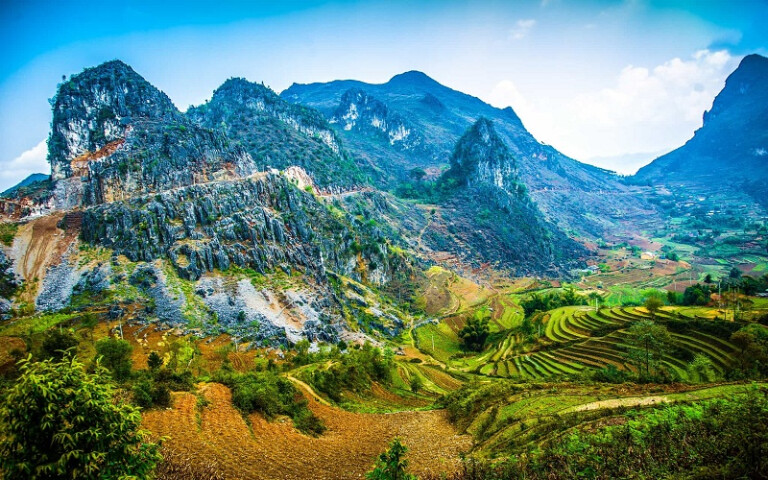
Geomorphologically, the plateau is a textbook tropical karst landscape — millennia of rainwater dissolving limestone have created razor-edged fengcong peaks, underground cave systems, sunken valleys, and deep gorges like Tu San canyon. Rock strata exposed along hillside roads allow scientists to read Earth's evolutionary history directly from exposed cliff faces. Fossils of ancient marine organisms — archaic corals, brachiopods, and crinoids — can be found at road level on certain sections of the Happiness Road, making the entire Ha Giang Loop an open-air geological pilgrimage.
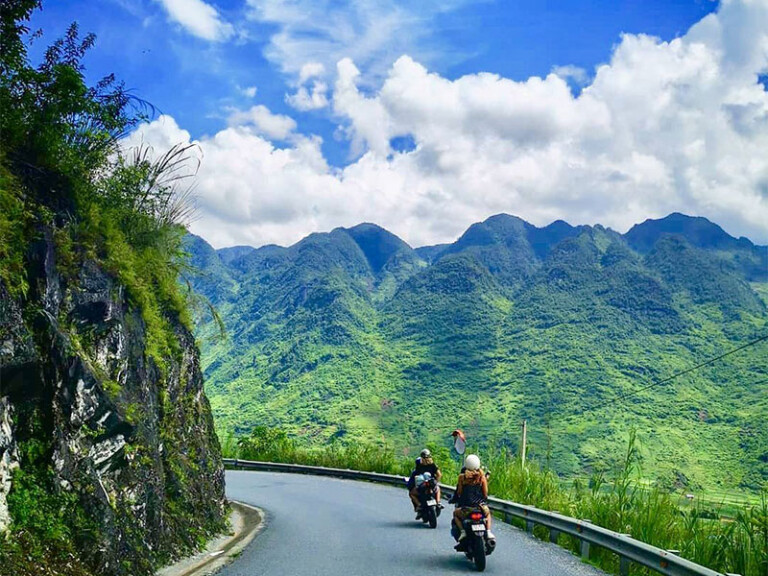
The plateau is also the cultural homeland of 17 ethnic minority groups, with H'Mong people comprising over 80% of the population. A 2,000-year symbiosis between humans and the karst landscape has produced unique agricultural systems: growing maize in rock crevices, channelling water through fissures, and building rammed-earth homes clinging to cliff faces. UNESCO regards this as one of the world's finest examples of sustainable human adaptation to karst terrain. Each year from October to December, buckwheat flowers bloom pink-white across the slopes — the plateau's unmistakable visual signature.
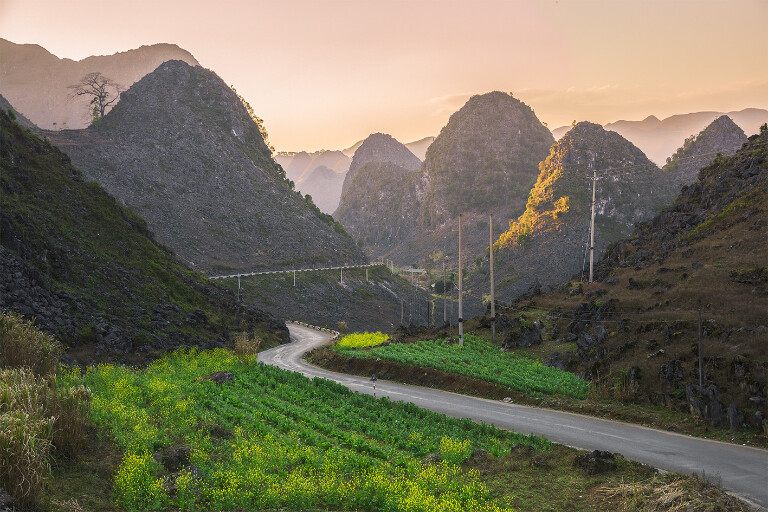
To fully explore the geopark, visitors should allow at least 3–4 days on the Ha Giang Loop (approximately 350 km), covering all four districts. The Geology Museum in Dong Van town is the ideal orientation stop before heading into the field. The roads through the geopark are ranked among the most scenic driving routes in Asia and draw hundreds of thousands of visitors annually from around the world.
Nowhere in Vietnam compresses more geological history into a single view than the Dong Van plateau — this is the Earth's open textbook, and you can stand on the page.
Tuổi Trẻ, 2025
Highlights not to miss.
The geopark divides into four zones: Quan Ba (Heaven's Gate and the legendary Twin Mountains), Yen Minh (pine forests and farming valleys), Dong Van (old quarter and Vuong Mansion), and Meo Vac (Tu San gorge and Ma Pi Leng Pass). Each zone represents a different geological period and a different cultural facet of the ethnic communities.
The Geopark Geology Museum in Dong Van town displays rock samples, fossils, and stratigraphic models that help visitors understand the plateau's complex geology. It is the ideal orientation stop before exploring in the field. The museum opens mornings and afternoons with flexible hours, and admission is free.
Each year from October to December, buckwheat flowers bloom pink-white across the rocky slopes and roadsides of the Dong Van plateau. H'Mong farmers grow buckwheat for its grain to ferment into wine — a crop uniquely adapted to the nutrient-poor rocky soil. Flower season draws the most visitors of any time of year and coincides with the Ha Giang Buckwheat Flower Festival.
The karst plateau can experience sudden dense fog, particularly April–September. Check weather forecasts for Dong Van specifically (not Ha Giang city). Temperatures can be 10–15°C cooler than lowland areas — bring warm layers even in summer.
How to visit & get there.
Planning Your Route **Allow at least 3–4 days** to cover all four zones on the Ha Giang Loop. **Start from Ha Giang city**, travelling through Quan Ba → Yen Minh → Dong Van → Meo Vac and back. **Rent a motorbike** (150,000–250,000 VND/day) for maximum flexibility.
Key Stops **Visit the Geology Museum** in Dong Van town — 30 minutes there deepens your understanding of everything you will see on the road. **Look at exposed rock strata** on hillsides — these are pages of geological history you can actually touch.
Sources
- 1.Cao nguyên đá Đồng Văn lần thứ ba nhận danh hiệu di sản
VnExpress · 2026-06-16
- 2.Cao nguyên đá Đồng Văn nhận giải thưởng Điểm đến khu vực hàng đầu thế giới
Tuổi Trẻ · 2026-06-16