History & story.
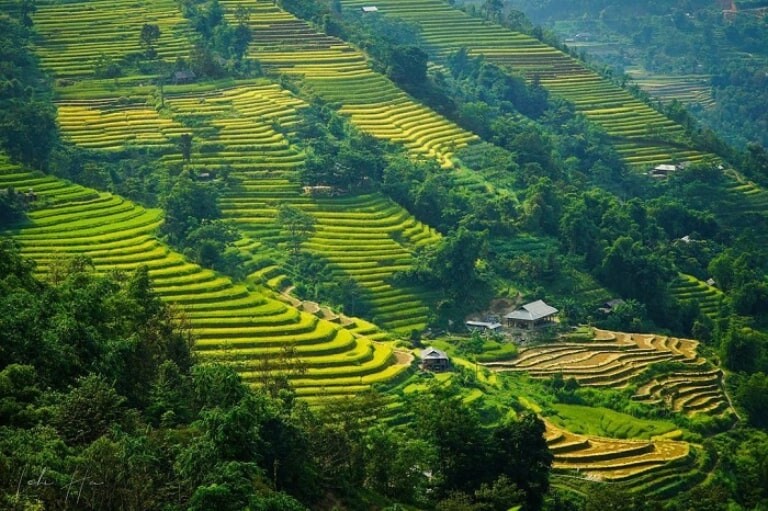
Hoang Su Phi's terraced rice fields span 3,700 hectares across 24 communes in Hoang Su Phi district, Ha Giang province. This agricultural landscape was carved over centuries from hillsides averaging 25–30 degrees of slope by La Chi, Dao, Nung, and Phu La communities. No machinery, no concrete — farmers used only hoes, spades, and hand-built irrigation channels of bamboo and earth. In 2012, the Ministry of Culture designated Hoang Su Phi's terraces a National Scenic Heritage — the first time in Vietnam an agricultural landscape received this distinction.
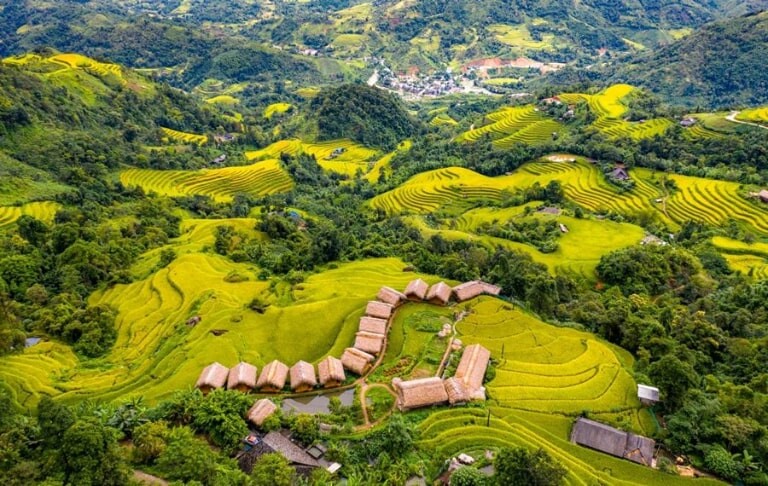
The irrigation system of Hoang Su Phi's terraces is a remarkable feat of engineering. The La Chi built a network of channels directing water from highland streams down through each successive terrace below, using the natural principle of communicating vessels. Each terrace level is retained by a low clay embankment — high enough to hold water but not so high as to cause landslides. The system requires no pumps or regulating valves — water flows from upper to lower levels by gravity through a complex network that only local farmers who have inherited centuries of knowledge can operate and maintain effectively.
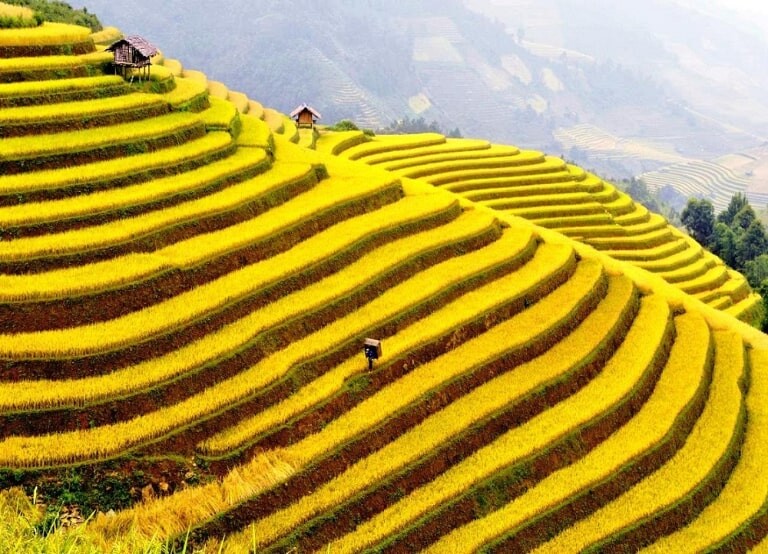
Hoang Su Phi's terraces completely transform in appearance with each season. The most spectacular is the September–October rice harvest when golden terraces cascade from valley floor to cloud-capped peaks, creating a breathtaking colour spectacle under morning light. In May–June, when water is flooded into the fields for transplanting, the silver terraces reflect sky and cloud like thousands of stacked mirrors. November through March brings yellow canola intercropping, draping the entire hillside in a soft golden hue.
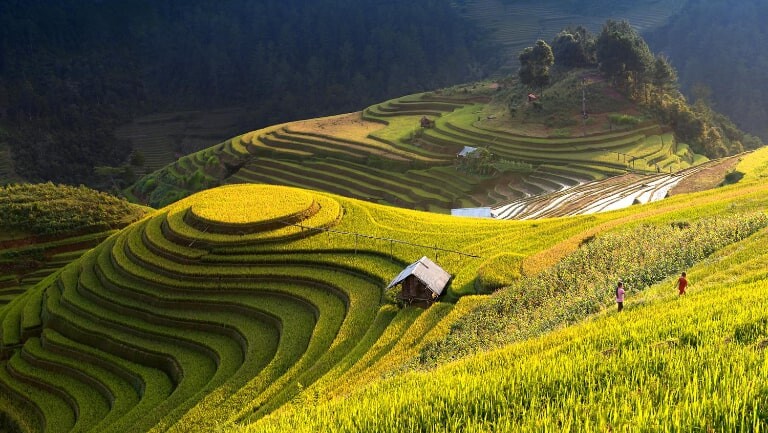
The La Chi communities — the indigenous people who created most of Hoang Su Phi's terraced system — remain tied to their fields across generations. The La Chi rice-field prayer ceremony (lễ cầu mùa) is held in spring at field-spirit shrines — a mandatory rite to invoke a good harvest before each planting cycle. About 20 km from Vinh Quang town, the communes of Ban Phung, Ho Thau, and Nam Ty have the densest and most beautiful concentrations of terraces. Many La Chi and Dao homestays in the area allow guests to stay and participate in seasonal farm work.
The terraces of Hoang Su Phi are not merely a scenic attraction — they are proof of highland engineering intelligence, written in earth and sweat across many centuries.
VietnamPlus, 2024
Highlights not to miss.
Among Hoang Su Phi's 24 communes, the three most renowned for terraces are Ban Phung, Ho Thau, and Nam Ty. Ban Phung has the densest and highest-stacking terraces and is most frequently chosen as the cover image. Ho Thau features wider terrace levels with ideal morning light angles. Nam Ty lies deeper but receives fewer visitors — ideal for those seeking undisturbed landscapes.
The La Chi are the indigenous owners of most of Hoang Su Phi's terraced landscape, with a national population of about 15,000. They have their own Kadai-group language, characteristic indigo-dyed hand-embroidered clothing, and harvest festivals tied to the agricultural calendar. Many La Chi families in Ban Phung and Ho Thau now run community tourism operations, offering homestays and guiding terrace visits.
Each year in September or October, Hoang Su Phi district hosts the Terraced Field Discovery Festival — an event combining traditional rice harvesting, ethnic performing arts, a regional market, and folk games. This is not only the period when the terraces look their finest but also the best opportunity to meet La Chi, Dao, and Nung communities in full traditional dress.
For the finest terrace photographs, climb to a hilltop or find a road viewpoint at least 100–200 metres above the terrace level. Early morning light (6:00–8:30 AM) from the east gives the warmest gold tones and sharpest shadows across the terrace layers. Avoid midday shooting when flat light eliminates the terraces' depth and dimension.
How to visit & get there.
Getting There From Ha Giang city, take National Road 2 or provincial roads west approximately **100 km** to Vinh Quang town — Hoang Su Phi district centre. **Renting a motorbike** is the best option; the road to Ban Phung and Ho Thau is paved but has some steep and narrow sections.
Timing and Tips **September–October is the golden period** — book homestays 2–3 weeks ahead as this is the busiest season. **Walk between terrace levels** for a closer experience — wear non-slip shoes as terrace embankments can be wet and slippery.
Sources
- 1.Ngắm ruộng bậc thang vào độ chín vàng ở Hoàng Su Phì
VnExpress · 2026-06-16
- 2.Khám phá Hà Giang qua miền di sản ruộng bậc thang Hoàng Su Phì
VietnamPlus · 2026-06-16