History & meaning.
The defining characteristic of Gầu Tào is the personalisation of a community festival. Unlike the H'Mong New Year (fixed community calendar) or the Khèn Mông Festival (organised by province or district), Gầu Tào is a ceremony belonging to one specific family with a specific reason — but carried out in a way that invites the entire community to participate. The host family bears all organisational costs — food, rice wine, the bamboo pole, musicians, competition prizes. This is a collective act of giving: the family thanks the spirits by giving joy to the community. This social structure reflects core H'Mong values: individual wealth has its greatest meaning when shared as communal benefit.
Horse racing in Gầu Tào is one of the most impressive ethnic sporting experiences in Ha Giang. Ha Giang highland horses — a small-bodied, short-legged breed that is extraordinarily strong and sure-footed on slopes — are brought to an open area on a hillside. Riders, typically young H'Mong men, sit without a saddle in traditional style and charge the horse along a steep downhill straight. There are no barriers and no official track — only the natural hillside, the crowd on both sides, and shouting. The horse is led to the top then released downhill — a single race typically takes only 20–30 seconds. The combination of speed, terrain, and the way the rider controls a saddleless horse entirely through body position makes Gầu Tào horse racing entirely unlike any flatland equestrian event.
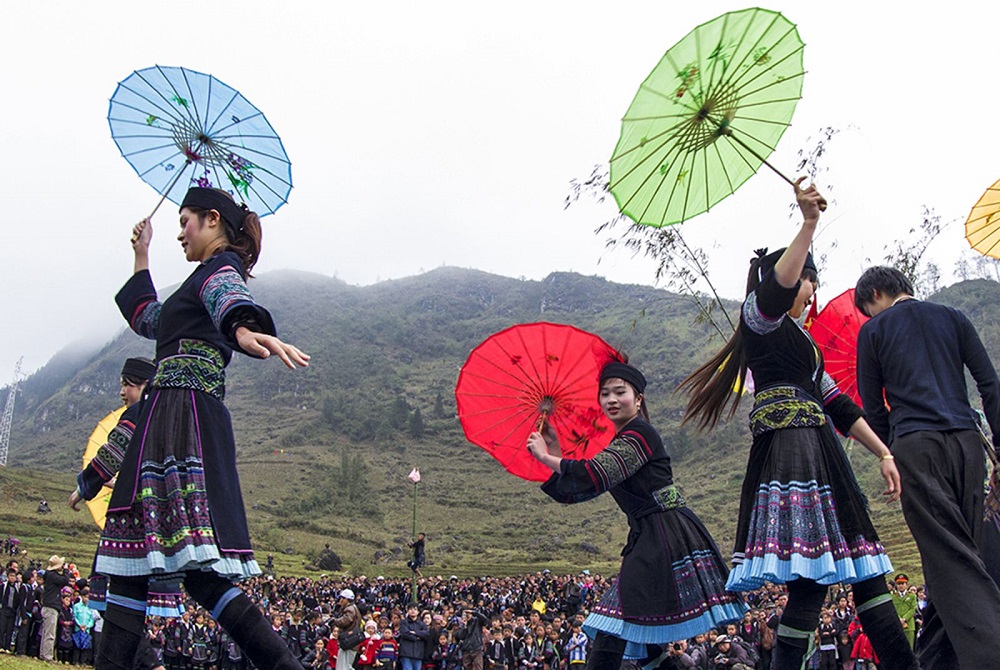
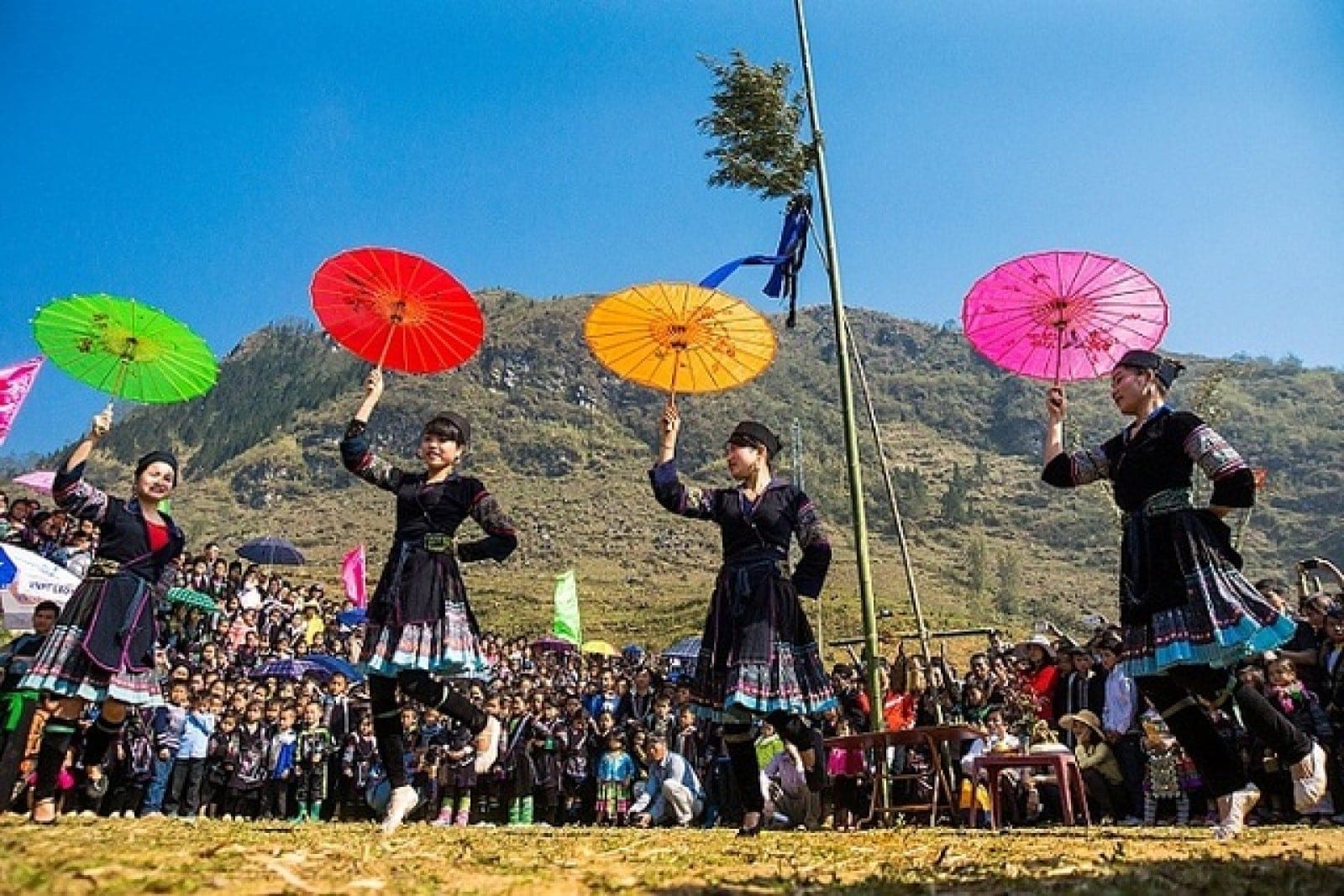
Music in Gầu Tào is richer than in most H'Mong festivals because this is an occasion of joy, not solemn ceremony. The khèn Mông sounds throughout all three days — not the funeral pieces but the joyful spring tunes and courtship melodies. The đàn môi jaw harp and H'Mong bamboo flute create a second layer of music, more intimate and close-range. Particularly notable is the call-and-response courtship singing between H'Mong men and women during Gầu Tào: one side sings a question, the other must respond with an answer that is both rhyming and clever enough to serve as a counter-challenge.
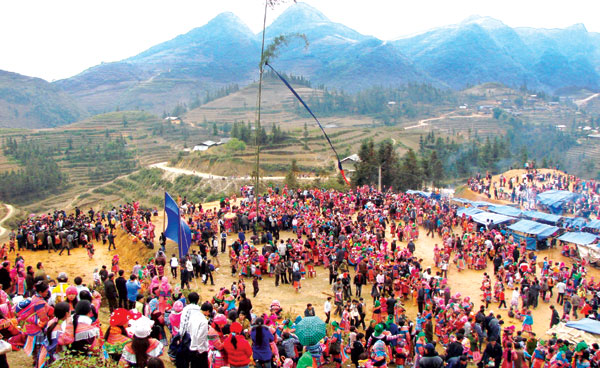
Experiencing Gầu Tào as a visitor is distinctive precisely because of its privacy and lack of scripting. There is no printed programme, no audience seating, no section reserved for outsiders. If invited by the host family, visitors sit and eat with local residents, hear the explanation of why that particular family is holding Gầu Tào — and each occasion is a different story. This is the only way to genuinely understand why the H'Mong hold this ceremony: not because tradition compels them, but because they genuinely want to say thank you — and they say that by inviting the entire community to share in the joy.
The spirits helped us — we must give thanks loud enough for the whole village to hear.
Lý giải của gia đình H'Mông tổ chức Gầu Tào tại Đồng Văn
Highlights not to miss.
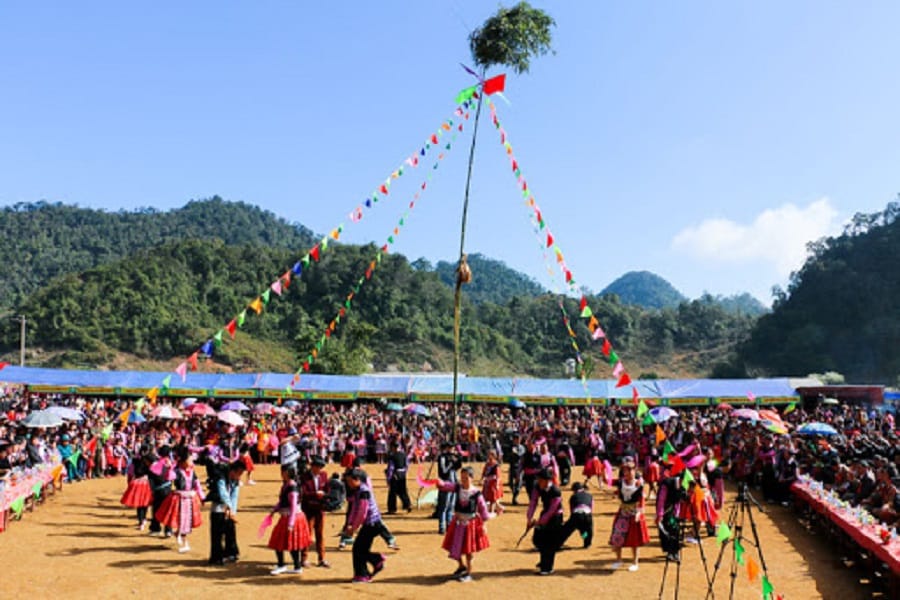
The bamboo pole with red cloth strips is Gầu Tào's most recognisable symbol across all H'Mong communities. The red colour is not arbitrary — in H'Mong philosophy, red is the colour of vitality, good fortune, and divine power. The pole is planted at the highest visible position so the spirits can see it from afar and know the vow is being fulfilled. After the three festival days, the pole is lowered through a formal ritual — it must never be pulled out arbitrarily, as this could cause the spirits to interpret the act as the vow being withdrawn.
Ha Giang horses are a special mountain breed selectively developed by the H'Mong over centuries — small-bodied and low-legged but capable of galloping down steep slopes and across rocky terrain that no horse from other regions can follow. Horse racing in Gầu Tào has no complex rules: ride downhill, no saddle, no barriers, first to arrive wins. H'Mong riders control the horse entirely through their legs and body position — a wholly indigenous equestrian technique learned from no riding school.
Courtship singing in Gầu Tào is a genuine contest of intelligence disguised as music. Two sides (typically men and women, or two groups) sing in alternating call-and-response — one side poses a question in rhyming verse, the other must respond immediately with an equally rhyming answer plus a new challenge. The loser is the side that cannot respond or responds too slowly. Those who sing best receive special community esteem — this is the highest form of intellectual display in H'Mong culture.
The horse racing track in Gầu Tào runs along a steep slope — the audience stands on both sides. The best viewing position is not the finish area (the flat ground below) but the mid-slope, where horses are at maximum speed and closest to the crowd. Arrive early and climb up the hillside to select your position before the crowd gathers.
How to attend & get there.
Finding Gầu Tào in Ha Giang
Gầu Tào has no official schedule because it belongs to individual families — but it concentrates most densely during the 1st–3rd day of the 1st lunar month. The most effective approach is staying at an H'Mong homestay during this period and asking the host. If a family in the area is holding Gầu Tào, the homestay owner will know and can accompany you or make an introduction. Do not expect to find information online — Gầu Tào is not publicised.
Conduct as a Guest of the Host Family
Do not arrive empty-handed — bring a bottle of rice wine, a box of cakes, or a packet of tea as a gift for the host family. When seated at the meal, accept everything offered — declining food or drink in this context can be interpreted as disrespect. Do not ask about the family's reason for holding Gầu Tào immediately — let that story come naturally when the family is ready to share it.
Sources
- 1.Lễ hội Gầu Tào — nét đẹp văn hóa của người H'Mông
Báo Dân tộc và Phát triển · 2026-06-21
- 2.Lễ hội Gầu Tào — văn hóa xuân H'Mông
Sở Du lịch tỉnh Hà Giang · 2026-06-21
- 3.Lễ hội Gầu Tào Hà Giang
Tổng cục Du lịch Việt Nam · 2026-06-21