History & story.
The canal that gave rise to this street was dug in 1790 by Nguyễn Ánh — later King Gia Long — to draw water from the Saigon River into the newly built Bat Quai citadel. Local people called it 'Kinh Lớn' (Grand Canal) or 'Chợ Vải' (Fabric Market) because Chinese merchants selling cloth clustered along its banks. After France seized Saigon in 1861, Admiral Charner named the canal after himself; in 1887 the canal was filled in and the two banks merged into Boulevard Charner — the main commercial artery of colonial Saigon lined with grand hotels, banks and showrooms. In 1956 the Republic of Vietnam government renamed it Nguyen Hue after the heroic emperor. In April 2015 the entire boulevard was transformed into a pedestrian street at a cost of 430 billion VND: 670 metres long, 64 metres wide, polished black granite paving, two fountains, LED lighting, and complete underground infrastructure.
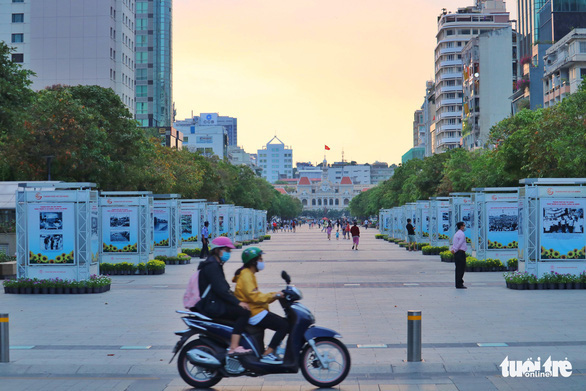
At the northern end of the street stands the 1908 City Hall — one of the most beautiful surviving French neoclassical buildings in Southeast Asia, lit warm yellow at night. In front of the building, the bronze Ho Chi Minh statue inaugurated May 17, 2015 looks straight toward the Saigon River along the full 670-metre length of the boulevard. At the southern end is Bach Dang Riverside, and across the river Thu Thiem with its modern glass towers reflects the city lights at night. City Theatre metro station (opened December 2024, Line 1) is 6 minutes on foot from the top of the pedestrian street, making Nguyen Hue the intersection between modern public transit and the central pedestrian space.
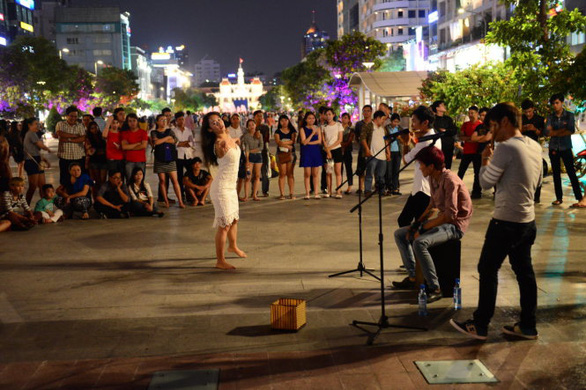
Nguyen Hue Walking Street is one of the rare public spaces in Saigon where all social classes are present simultaneously: international tourists alongside street vendors, suited businesspeople alongside ordinary families taking commemorative photographs, native Saigonese alongside migrants from every province. It is the venue for the city's largest events — the Tet flower market (a tradition since 1960), book fairs, art exhibitions, international sporting event opening ceremonies and New Year's Eve fireworks all unfold along this axis. Stepping onto Nguyen Hue on any evening of the year — whether an ordinary Tuesday or a blazing Tet night — is stepping directly into the true heartbeat of Vietnam's largest city.
This is not a street — it is the city's timeline, where three centuries overlap in every metre of granite.
— Kiến trúc sư Ngô Viết Nam Sơn, phỏng vấn Tuổi Trẻ về quy hoạch phố đi bộ Nguyễn Huệ, 2015
Highlights not to miss.
The bronze Ho Chi Minh statue inaugurated on May 17, 2015 — marking the 125th anniversary of his birth — stands in a garden looking straight at the 1908 French neoclassical City Hall designed by architect Fernand Gardès. The two structures stand 670 metres apart along the pedestrian street's straight axis, creating an urban vista rare in Southeast Asia — where resistance history and colonial architecture face each other directly. In the late evening when the City Hall building is lit in warm yellow, the shot from the statue back toward the building is one of Saigon's most beautiful views.
The tradition of displaying Tet flowers along Nguyen Hue began in 1960, before the road was upgraded to a pedestrian street. In the week before Lunar New Year, the entire 670-metre stretch transforms into a flower market with Southern yellow apricot blossoms, Northern pink peach flowers, marigolds, gladioli and dozens of tropical flower varieties. From 2026, for the first time in the modern event's 23-year history, the Tet flower street added a night edition with LED decorative lighting — a completely new experience for Saigonese and visitors.
Two large fountains along the pedestrian street shoot water synchronized to music on Friday, Saturday and Sunday evenings, combined with LED lighting covering the entire granite surface. From 7 PM on weekends, surrounding streets also close to traffic, turning the whole central area into a vast pedestrian zone with spontaneous street art performances. This is when the walking street truly becomes the city's 'living room' — where every social class shares the same open space simultaneously.
The eastern end of the walking street opens onto Bach Dang Riverside — where the Saigon River and the modern glass towers of Thu Thiem across the water create a dramatically contrasting frame of old and new. It is the ideal spot to watch New Year's Eve fireworks — on December 31, the sky above the Saigon River blazes and hundreds of thousands of people pour onto the riverside to watch. From Bach Dang, ferries and river boats to Thu Thiem and other riverside destinations depart regularly — the most relaxed way to explore the Saigon River.
Come at around 6:30–7:00 AM to photograph the polished granite reflecting the City Hall before crowds arrive. Friday evenings are liveliest: fountains start at 7 PM and side streets close to traffic. During Tet (January–February), browse the evening flower market and buy a yellow apricot branch — a souvenir found nowhere else.
How to visit & get there.
Getting There
Nguyen Hue Walking Street is in central District 1, walkable from most hotels in the area. City Theatre metro station (Line 1, opened December 2024) is about 6 minutes on foot from the top of the walking street — the fastest way here. Ben Thanh metro station (also Line 1) is about 5 minutes from the bottom end. Grab is the most convenient option outside metro hours.
When to Visit & What Not to Miss
Friday and weekend evenings are the liveliest — fountains operate to music from 7 PM and surrounding streets close to traffic. Early morning before 7 AM is the quietest time to photograph the polished granite reflecting the City Hall building. The week before Lunar New Year (January–February): the flower market is at its most spectacular — come in the evening to see the blooms under LED lighting. Combine with a stop at Bach Dang Riverside at the far end to watch the Saigon River and passing boats.
Sources
- 1.Đường Nguyễn Huệ — dòng kênh thành quảng trường đi bộ đầu tiên
VnExpress · 2026-06-06
- 2.Đường nước xưa làm nên 5 đại lộ sang trọng giữa Sài Gòn
Tuổi Trẻ · 2026-06-06
- 3.Ho Chi Minh City flower street debuts first night edition at Tet 2026
Tuổi Trẻ News · 2026-06-06