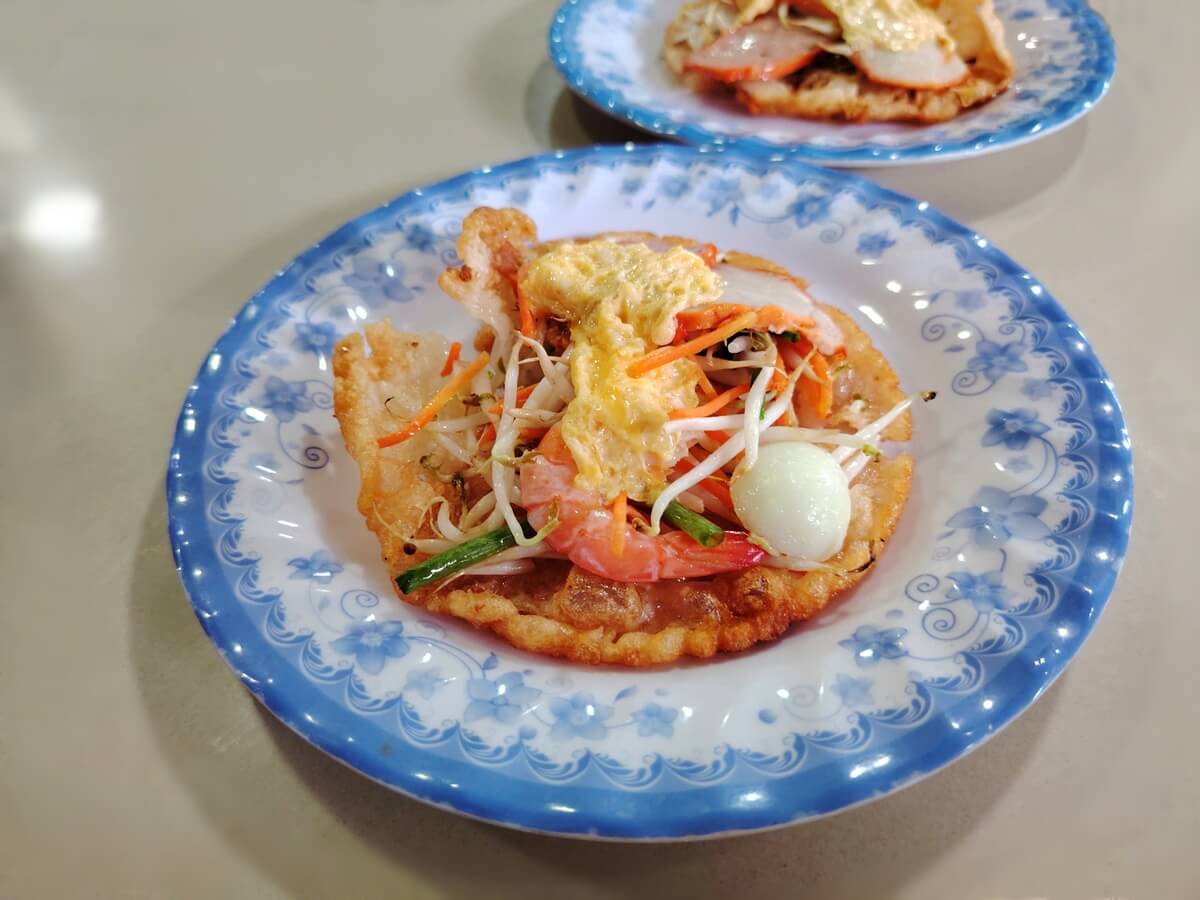
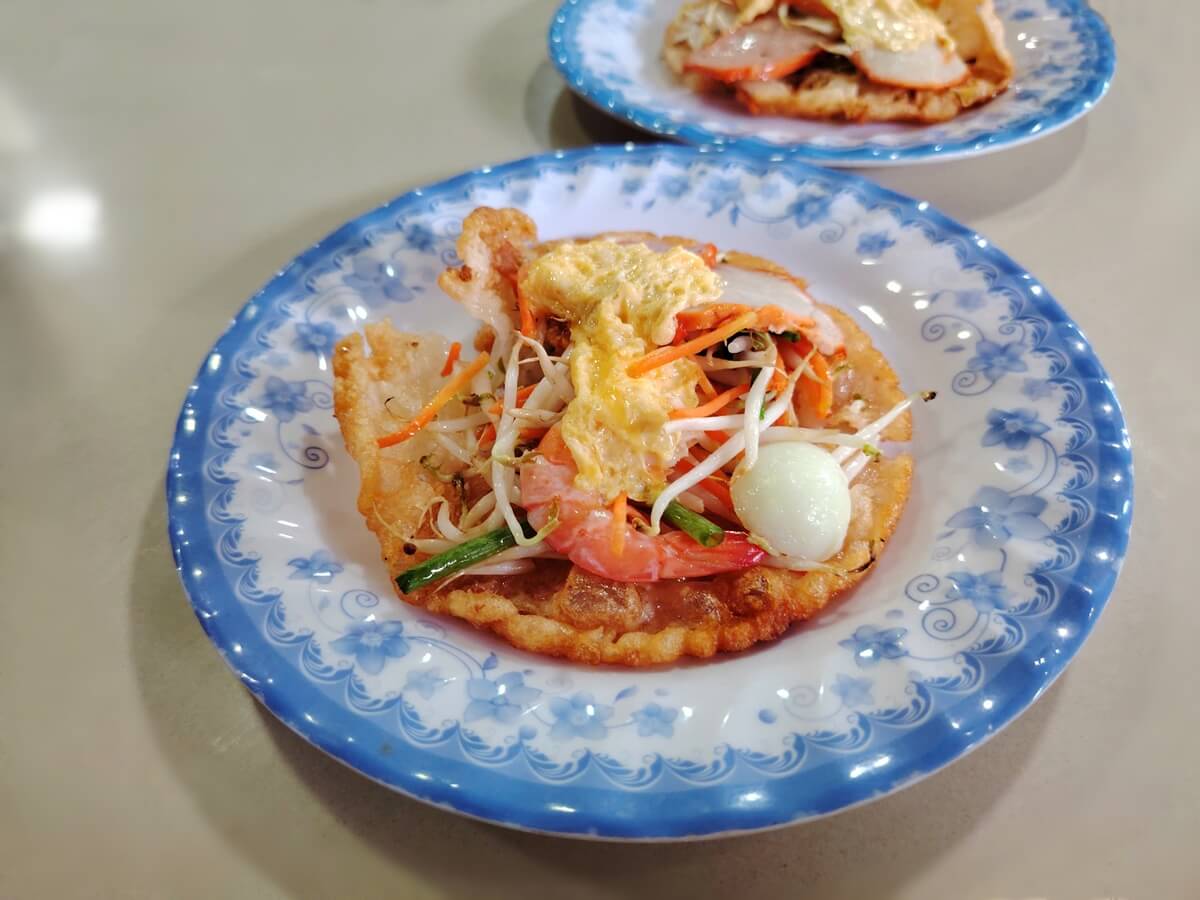
Story & history.
Banh khoai is Hue's signature crispy golden pancake — though related to the southern banh xeo, Hue's version is smaller, crispier, and served with a thick, rich dipping sauce rather than diluted fish sauce, creating an entirely distinctive identity. The name 'khoai' in Hue dialect means delight, pleasure — the pancake was named for the joyful sensation of hearing batter sizzle into a pan of hot oil and watching the cake puff up golden. The traditional banh khoai filling includes pork belly, fresh shrimp, bean sprouts, and a whole egg yolk pressed into the center — this combination delivers a richness that is crackling-crisp outside and soft and fragrant within. Banh khoai is cooked in small cast-iron pans in lard or cooking oil — the loud sizzle as batter hits the hot pan is the defining sound of banh khoai stalls along Dinh Tien Hoang street near the Perfume River.
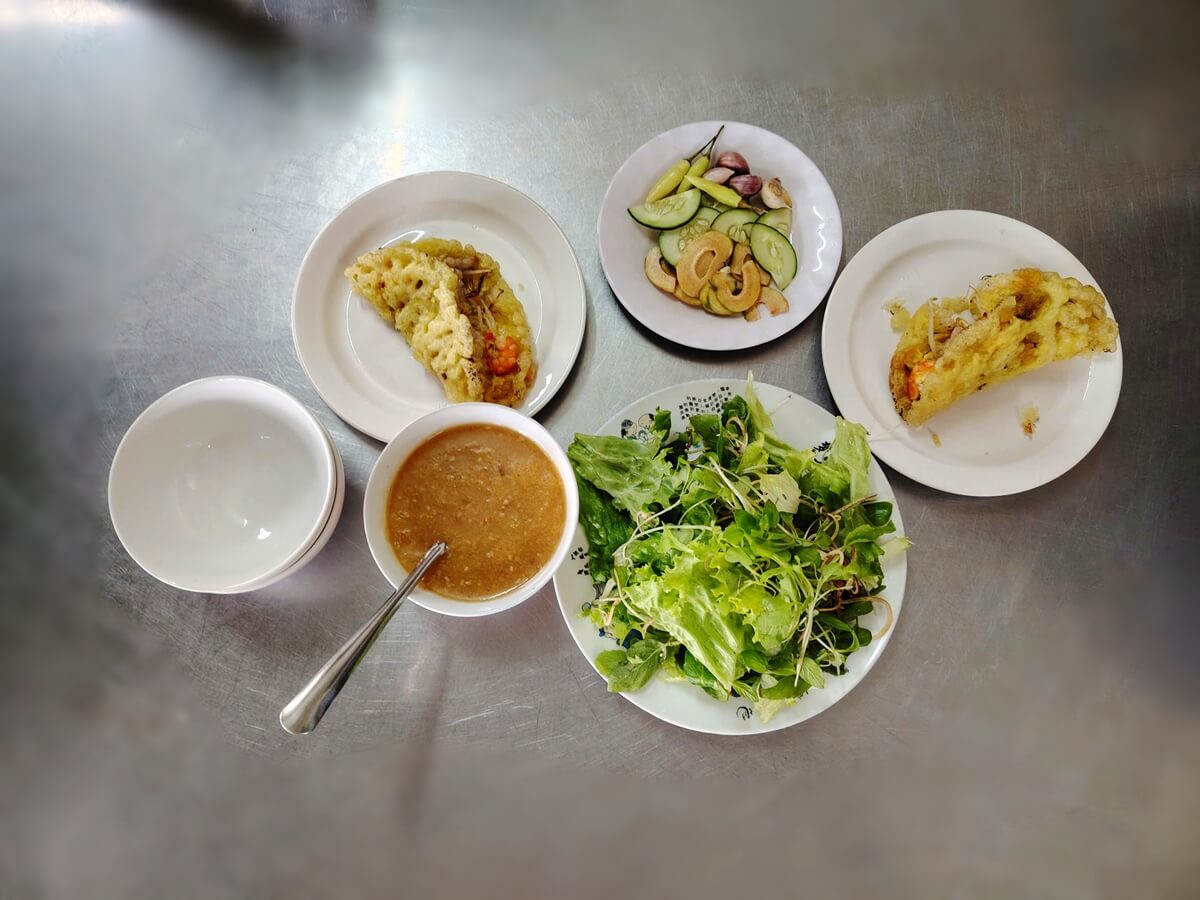
The dipping sauce served with banh khoai — called 'tuong banh khoai' — is the irreplaceable condiment that defines the dish's reputation: roasted peanuts pounded fine, mixed with minced pork liver, toasted sesame, sugar, chili, and dozens of other spices, cooked down into a thick, dark red-brown aromatic paste. Every famous banh khoai stall in Hue guards its sauce recipe like a trade secret, and this tuong is what separates an excellent shop from an ordinary one. Banh khoai is eaten by wrapping in green mustard leaf or fig leaf with an assortment of fresh herbs before dipping in the sauce — this method creates a perfect balance between the richness of the pancake and the freshness of the greens. The most celebrated banh khoai street in Hue is Dinh Tien Hoang road, lined with dozens of stalls packed side by side, smoke rising continuously and sizzling sounds filling the air from morning to night.
Banh khoai was once a special dish reserved for banquets and important celebrations because making it required considerable effort and ingredients. Today banh khoai has become an everyday street food yet retains its careful and elaborate preparation. Foreign visitors are often surprised to discover that Hue's banh khoai and the southern banh xeo — though both translated as 'sizzling cake' in English — are in fact two entirely different dishes in size, crispiness, filling, and above all in their dipping sauce. Eating banh khoai at a sidewalk stall on Dinh Tien Hoang street on an afternoon, looking out over the glittering Perfume River — it is a dining experience that satisfies both the palate and the spirit in a way uniquely possible only in Hue.
"Without nước lèo, bánh khoái is just another pancake — the dipping sauce is the soul, the thing that makes it uniquely Hue."
— Tuổi Trẻ, "Không có nước lèo, bánh khoái về đâu?"
Ingredients — what makes the flavour.
The nước lèo is freshest when **the restaurant first opens** — simmered all morning, it reaches optimal thickness and fragrance by midday. Late afternoon sauce may be thinner from repeated reheating. Choose shops with **individual cast-iron pans** — each pancake cooked in its own pan — the traditional technique ensuring consistent crispness.
How to enjoy it properly.
Dip, Don't Wrap Unlike southern bánh xèo which is rolled in lettuce, Hue's bánh khoái is **cut in half** and dipped directly into the nước lèo. Place a piece on a lettuce leaf, add shaved banana blossom, herbs, and a sliver of star fruit — fold gently and submerge in the thick sauce.
Working with the Sauce The nước lèo should be **thick and warm** — never watery or cold. A good restaurant keeps it simmering over a low flame. After dipping the pancake, add a pinch of **fresh minced chili** to the sauce bowl to cut through its richness. Nem lụi (grilled pork sausage) is traditionally served alongside — bánh khoái's classic pairing in Hue.
Editor-recommended eateries.
ⓘ Addresses and prices may change. Please verify before visiting.