History & story.
Khai Dinh Mausoleum — the last and most singular of the Nguyen royal tomb complex — was begun in 1920 and completed in 1931, 11 continuous years being the longest construction period of any Nguyen tomb. The entire structure is built into Chau Chu Mountain at 127 meters elevation, requiring a climb of 127 stone steps to reach the main gate — the number 127 chosen deliberately by the imperial court's geomancers according to numerological feng shui. The enormous construction cost was largely funded by raising taxes on the general population by 30% — a decision that prompted the writer Phan Chu Trinh, in exile in Paris, to pen the famous 'Letter of Seven Accusations' cataloguing seven transgressions of the emperor, one of the most unsparing public critiques ever levelled at a Nguyen ruler. The architecture is an unprecedented fusion of styles: Romanesque spires beside East Asian curved rooflines, cast-iron balustrades beside French reinforced concrete columns, Chinese dragon-phoenix ornament beside Art Deco borders — the product of an emperor living between two cultures who refused to choose. The entire complex stands as living evidence of French Indochina as a period when East and West were learning to speak to each other.
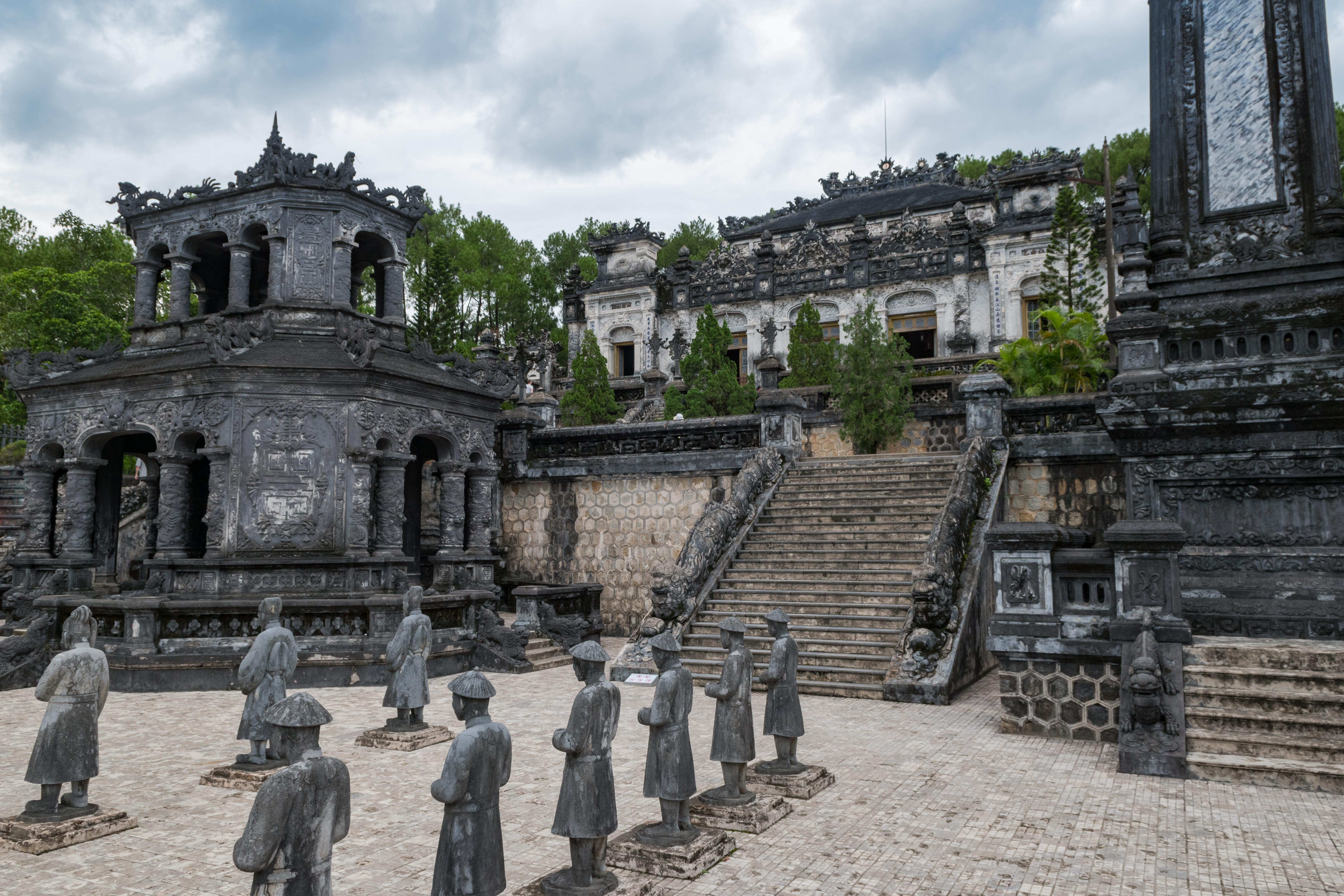
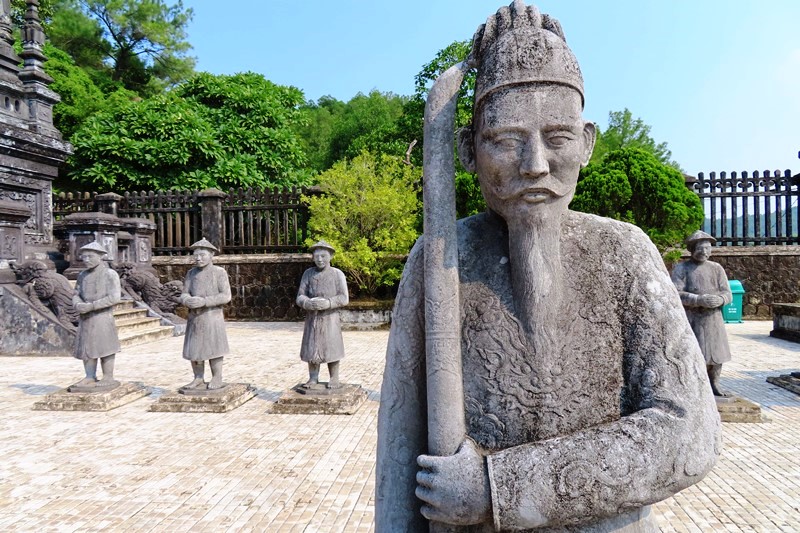
Flanking the middle courtyard are rows of large stone mandarins, soldiers, elephants, and horses — a form of royal honour guard inherited from classical Chinese imperial tomb conventions but rendered in a more naturalistic Vietnamese sculptural style. Viewed from the outer courtyard looking up through the successive terraces, the structure appears to ascend toward the sky — a carefully calculated visual effect. But the true wonder of Khai Dinh Mausoleum lies inside Thien Dinh Palace — the inner shrine hall above the burial vault — where every wall, ceiling, and column is completely covered with millions of porcelain fragments, coloured glass, and small gems assembled into cloud dragons, seasonal plants, and natural landscapes. Three monumental ceiling paintings executed in Western oil technique combined with traditional Vietnamese dragon-cloud motifs are the work of artist Phan Van Tanh, who spent over two years on the triptych alone. Light filtering through stained-glass windows creates an extraordinary shimmer at morning — this is the most beautiful and haunting interior space in the entire Hue mausoleum system.
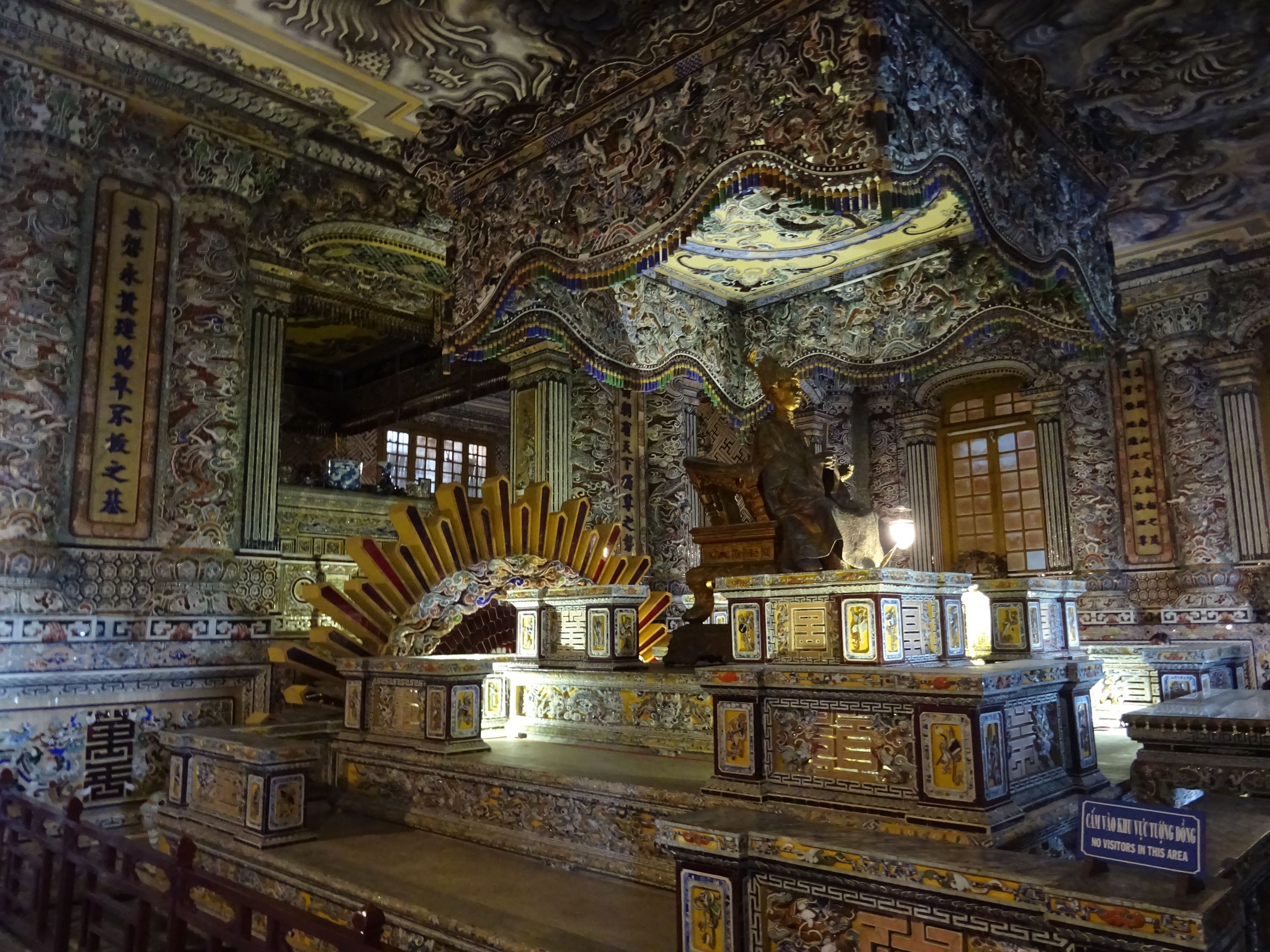
The life-sized bronze statue of Emperor Khai Dinh, cast in France in 1920, gilded and enthroned directly above his burial vault, is the most remarkable portrait artefact in the entire Nguyen mausoleum system. Unlike other tombs which venerate through memorial tablets or painted portraits, Khai Dinh's enshrines through a realistic cast likeness — and the burial vault containing the emperor's remains lies directly below the throne, the distance between statue and tomb only centimetres. Khai Dinh Mausoleum attracts more academic debate than any other Nguyen tomb: some scholars view it as a prime example of colonial-era cultural hybridization, while others see it as evidence of Vietnamese artisans' creativity. Whatever one's perspective, this is the most visually striking and haunting of the Nguyen tombs — visitors may disagree with its aesthetic but cannot remain indifferent. It is a site where the first visit is only the beginning — the ceramic mosaic interior of Thien Dinh Palace reveals more detail with each return.
The restoration and conservation project at Khai Dinh Mausoleum is being implemented under a long-term plan — numerous ceramic mosaic sections damaged over time by climate and humidity are being repaired by artisans using traditional techniques. This work is not merely heritage conservation but the maintenance of a distinctive Hue craft at risk of being lost. Each replacement fragment must match the original surrounding material in colour, gloss, and texture — work requiring the trained eye and skilled hands of craftspeople continuing a tradition hundreds of years old. Today, Khai Dinh Mausoleum is one of the most visited attractions in the Hue Heritage Complex, drawing millions of visitors annually — an unmissable stop on any Hue itinerary.
Khai Dinh Mausoleum is where East and West meet — not in conflict, but in the creativity of Vietnamese craftsmen working for an emperor who refused to choose.
Vietnam Tourism Board
Highlights not to miss.
The interior of the main palace is the apex of Vietnamese ceramic mosaic art — every wall, ceiling, and column covered with millions of porcelain fragments, coloured glass, and small gems assembled into cloud dragons, seasonal plants, and natural landscapes. Three monumental ceiling paintings executed in Western oil technique combined with traditional Vietnamese dragon motifs are the work of artist Phan Van Tanh, who spent over two years on the triptych alone. Light filtering through stained-glass windows at morning creates an extraordinary shimmer — this is the most beautiful and haunting interior space in the entire Hue mausoleum system.
The life-sized bronze statue of Emperor Khai Dinh in full imperial regalia, cast in France in 1920 and shipped to Hue, is enthroned directly above his burial vault. Its face is said to closely resemble the emperor's actual features, creating a presence simultaneously majestic and strangely intimate. This is the most remarkable portrait artefact in the entire Nguyen mausoleum system — while other tombs venerate through memorial tablets or painted portraits, Khai Dinh's enshrines through a realistic cast likeness. The burial vault containing the emperor's remains lies directly below the throne — the distance between the statue and the tomb a matter of centimetres.
The mausoleum is built into the hillside through multiple ceremonial terraces connected by 127 stone steps — the number 127 deliberately chosen by the imperial court's geomancers according to numerological feng shui. Flanking the middle courtyard are rows of large stone mandarins, soldiers, elephants, and horses — a form of royal honour guard inherited from classical Chinese imperial tomb conventions but rendered in a more naturalistic Vietnamese sculptural style. Viewed from the outer courtyard looking up through the successive terraces and stairways, the structure appears to ascend directly toward the sky — a visual effect carefully calculated by the court architects.
What makes Khai Dinh Mausoleum unique among the seven Nguyen royal tombs is its unprecedented architectural hybridization: Romanesque spires beside East Asian curved rooflines, cast-iron balustrades alongside French reinforced concrete columns, Chinese dragon-phoenix ornament beside Art Deco borders and Celtic-inspired tracery. This is not accidental — it is the product of an emperor living between two cultures who refused to choose. That refusal to choose created the most singular structure in the Nguyen mausoleum system — and living evidence of French Indochina as a period when East and West were learning to speak to each other.
Bring a small torch or use your phone flashlight to illuminate the porcelain inlay details in the darker corners of the main hall — many of the finest motifs are on the ceiling and upper walls where natural light barely reaches.
How to visit & get there.
Getting There
Khai Dinh Mausoleum lies about 10 km from central Hue on the road toward Tu Duc and Minh Mang mausoleums. The most convenient options are renting a motorbike or electric bicycle along Le Ngo Cat Street, or hiring a xe om or taxi. Most Hue tour operators bundle Khai Dinh with Tu Duc Mausoleum and Thien Mu Pagoda for an efficient full-day itinerary — the most effective way to see all three in one trip. Adult tickets VND 150,000 / children VND 30,000; open 7:00–17:30 daily.
Important Practical Notes
The mausoleum involves steep stone stairways that may be challenging for visitors with mobility difficulties — wear shoes with good grip. Dress modestly. Allow at least 60–90 minutes to explore properly, paying particular attention to Thien Dinh Palace interior — this is the site's defining wonder and rewards slow, close inspection. Bring a small torch or use your phone flashlight to illuminate porcelain inlay details in darker corners — the finest mosaic work is on the ceiling and upper walls where natural light barely reaches.
Sources
- 1.Lăng Khải Định — Nghệ thuật khảm sành sứ độc đáo
Trung tâm Bảo tồn Di tích Cố đô Huế · 2025-03-10
- 2.Khai Dinh Mausoleum — Vietnam Tourism Official Guide
Vietnam Tourism · 2025-03-14
- 3.Complex of Hue Monuments — UNESCO World Heritage
UNESCO · 2025-03-10