History & meaning.
The precise origins of Khau Vai Love Market are not documented in writing — as is the case with most folk culture of highland ethnic minority groups. The legend of the forbidden Nung-Giay lovers is typically situated in the late 19th or early 20th century. What is more certain is that the love market custom has existed since at least the early 20th century, mentioned in French ethnological documents about customs of northeastern Vietnam. Khau Vai Love Market was recognised by the Vietnamese state as a National Intangible Cultural Heritage — an interesting decision given that the custom being preserved appears, at first glance, to contradict conventional marriage norms.

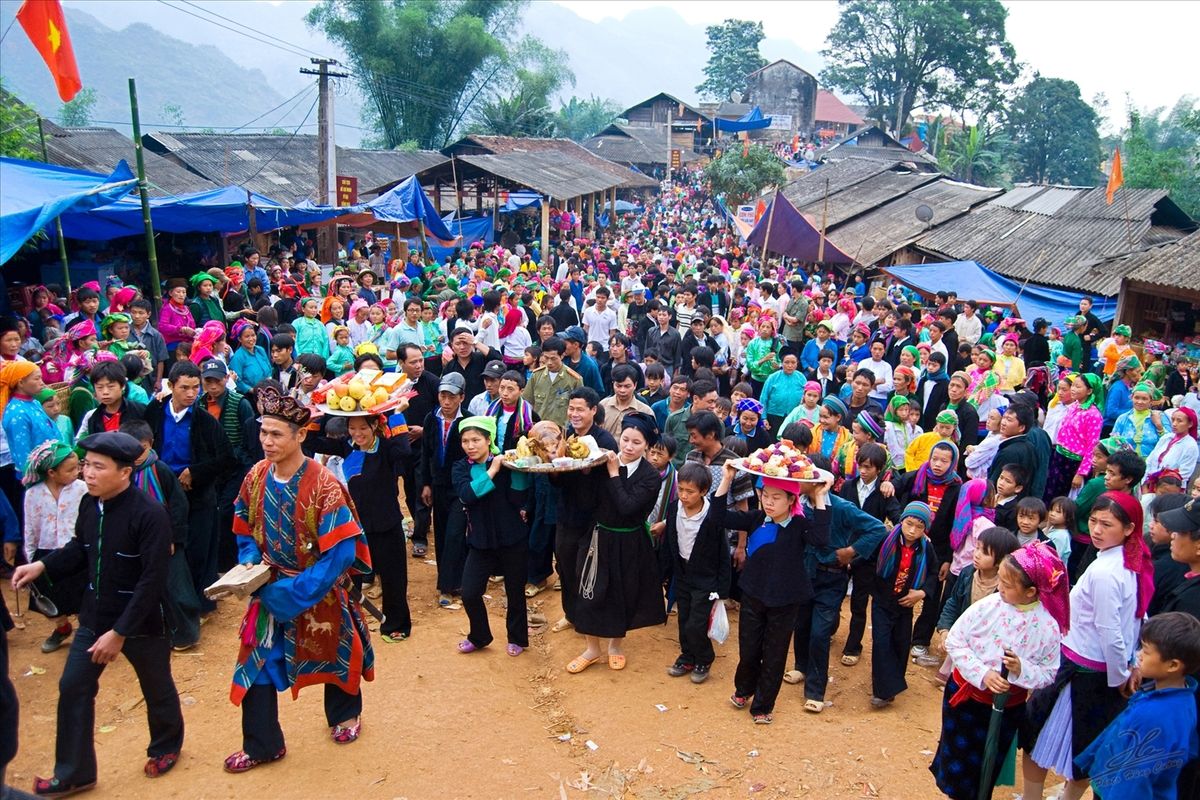
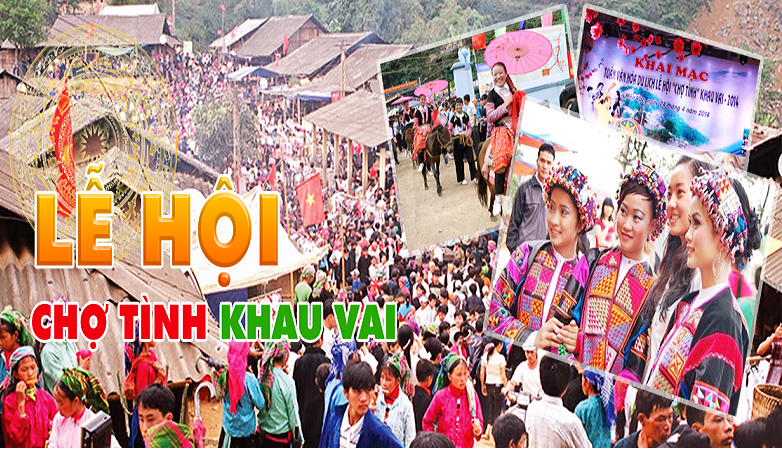
The love market day begins in the early morning as people from distant villages make their way to Khau Vai on foot and by motorbike. The morning and early afternoon carry the atmosphere of an ordinary periodic market: buying and selling, meeting relatives, eating. This is also when traditional performance groups appear — the singing of Red Dao women, the sound of H'Mong reed pipes, and the Tay đàn tính string instrument create a multi-ethnic soundscape rarely encountered. But from late afternoon onwards, the true love market begins — pairs separate from the crowd, finding quiet corners beneath trees or behind food stalls, and sit together for a period of time that the entire community quietly reserves for them.
The anthropology of Khau Vai Love Market challenges many Western assumptions about love, marriage, and fidelity. In a society where marriage is often arranged according to family and economic interests, the Love Market is a social mechanism that permits individuals — particularly women — to maintain a private emotional space that lies outside family duty. This is not a disruption of social order but a form of its equilibrium: by permitting one annual reunion, the community is actually protecting the stability of marriage for the remaining 364 days. For this reason, Khau Vai Love Market has never been a source of social conflict — the wife knows where the husband goes, the husband knows where the wife goes, and both return home before nightfall.
Attending Khau Vai Love Market as a visitor requires a mindset entirely different from conventional festivals. The private meetings between people — especially elderly couples who have been coming here for decades — are not a performance and not a photography subject. The late-afternoon atmosphere at Khau Vai is simultaneously joyful and melancholic in a very particular way: the laughter of the evening market, singing from somewhere in the darkness, and occasional dense silences of two old people sitting together without speaking — each carrying within them a lifetime of not meeting. This is the most profoundly human experience that Ha Giang can offer a visitor who knows how to observe.
There is only one day in a year — but that one day is enough to carry through the rest of the year without regret.
Câu nói lưu truyền của người già Mèo Vạc về Chợ Tình Khâu Vai
Highlights not to miss.
Nowhere else in the world has a formal custom permitting spouses to attend a market separately to meet former loves with the explicit acceptance of the entire community. This is not concealed infidelity — it is a public social ritual. That distinction is the core for understanding Khau Vai Love Market: it does not break marriages but creates psychological equilibrium for arranged marriages that did not originate from personal love.
Khau Vai Love Market is one of the few events in the Ha Giang highlands that brings together multiple ethnic minority groups simultaneously. Each group arrives in its distinctive dress — Red Dao with embroidered red headdress, H'Mong with embroidered hemp skirts, Tay with black indigo tunics — creating a visually rich multi-coloured space that is rarely encountered. The different ethnic languages and song melodies blend together in this single annual market.
The forbidden love story between the Nung man and the Giay woman is the cultural centre of Khau Vai Love Market — but few know the full details. Legend holds that after being forcibly separated by their two clans, both subsequently married other partners. Their vow to meet once a year was not a rejection of marriage but a way to preserve the memory and loyalty to a part of themselves that could not belong to an arranged marriage. When both eventually died, the community continued the custom as a way of honouring their memory.
The morning at Khau Vai Love Market is not very different from an ordinary periodic market — crowded, noisy, many stalls. From around 3:00 PM the crowds thin and the genuine meetings begin. If you only have a short window of time, choose the late afternoon — the space is quieter, the light is better, and the emotional atmosphere of the love market is finally, fully present.
How to attend & get there.
Getting to Khau Vai
Khau Vai is approximately 22km from Meo Vac town along Provincial Road 176. The road is narrow but well-surfaced and accessible by both motorbike and car. On the love market day (27th/3rd lunar month), crowds are very large — depart from Meo Vac before 8:00 AM to secure parking and a good position. If staying overnight in Meo Vac, book accommodation at least 2–3 weeks in advance as visitor numbers surge dramatically on this date.
Appropriate Conduct at the Market
Do not photograph faces closely of couples in the midst of private meetings — this is the most serious breach a visitor can commit at Khau Vai Love Market. Observe from a distance, do not intrude on others' conversations. Dress respectfully — long trousers, covered shoulders, neutral colours. The commercial market section is fully open for normal participation — shopping, trying local food, watching ethnic cultural performances.
Sources
- 1.Chợ Tình Khâu Vai — nét đẹp văn hóa của đồng bào dân tộc thiểu số
Báo Dân tộc và Phát triển · 2026-06-21
- 2.Chợ Tình Khâu Vai — Sở Du lịch Hà Giang
Sở Du lịch tỉnh Hà Giang · 2026-06-21
- 3.Chợ Tình Khâu Vai — Di sản văn hóa phi vật thể quốc gia
Tổng cục Du lịch Việt Nam · 2026-06-21