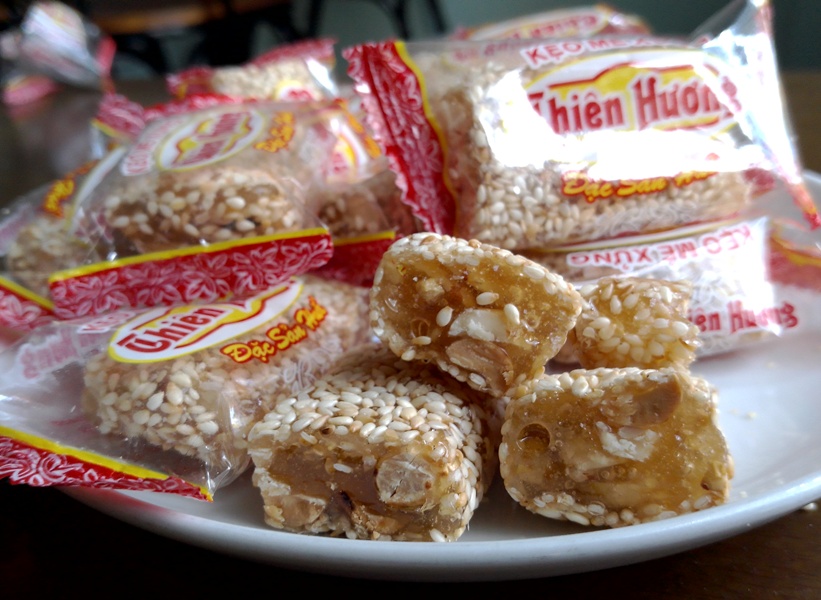
Story & history.
Me xuong is Hue's traditional signature candy made from sesame seeds, malt syrup, and sugar — a firm, lightly crisp white confection covered evenly with thousands of white sesame seeds, long established as the indispensable souvenir when arriving in or departing from the ancient capital. The origins of Hue me xuong are linked to the Nguyen dynasty's imperial confectionery tradition — when royal kitchen masters created refined sweets and candies to present to the emperor and use as diplomatic gifts. Mach nha — a thick liquid sugar extracted from rice sprouts — is the secret ingredient that gives me xuong its characteristic pliability: not hard like ordinary candy but with a gentle give that prevents shattering when bitten. The Thien Huong and Phu Huong me xuong brands in Hue have existed for decades and are exported to countries with Vietnamese diaspora communities, becoming culinary ambassadors of the ancient capital worldwide.
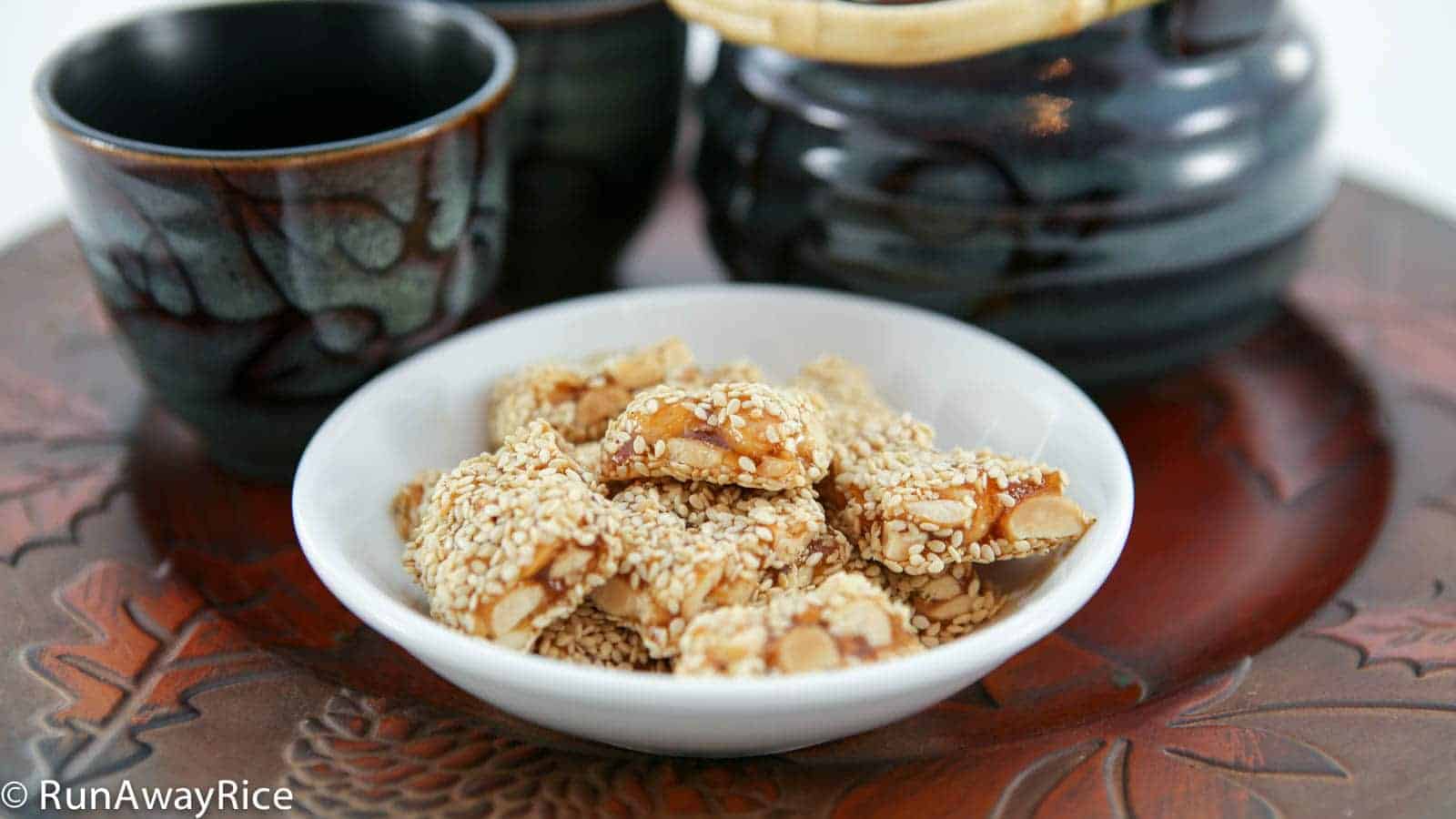
The traditional me xuong production process demands meticulous care and experience: sugar and malt syrup are cooked to precise temperature then hand-pulled repeatedly to create the characteristic airy texture and ivory color — this candy-pulling technique resembles traditional taffy-making but with far greater refinement. Toasted sesame seeds are folded into the warm candy mixture and then used to coat the outside of each bar before cutting into uniform squares or rectangles. Me xuong comes in several variations: the classic pure white sesame, versions with added roasted peanuts, and varieties incorporating ginger or durian — but the pure sesame original remains most beloved for the authentic fragrance and nuttiness of freshly toasted sesame. Each piece of well-made Hue me xuong offers a soft crunch when bitten and melts in the mouth with the lingering nuttiness of sesame and the clean sweetness of malt — simple but unforgettable.
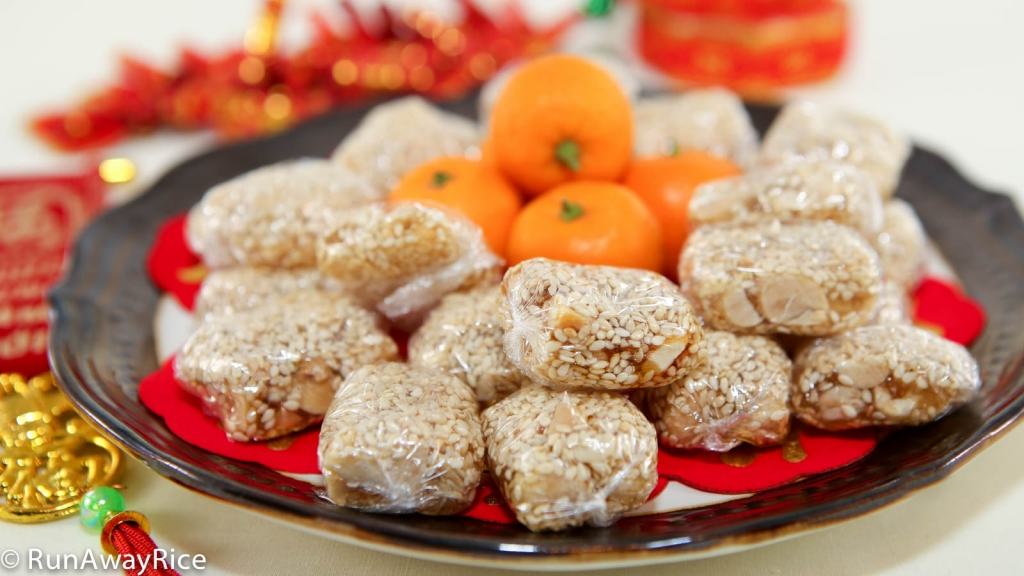
Me xuong is not just a casual snack but an important ritual object in Hue culture: used as an offering to ancestors on memorial days, placed on Buddhist altars, and essential on the Tet holiday ceremonial tray. The traditional me xuong craft in Hue is being actively preserved by family production workshops under pressure from industrial manufacturing and modern candy preferences. Kim Long street and the area around Dong Ba market concentrate the most traditional me xuong production and retail shops — glass display cases of me xuong alongside other Hue preserved sweets are an unmistakable image of the ancient capital's commercial life. Bringing home a box of Hue me xuong as a gift means carrying not just a delicious candy but a fragment of the ancient capital's memory and the devotion of craftspeople who have preserved this tradition across generations.
Eating a bar of Hue me xuong is tasting a hundred years of artisan confectionery history — sweet but not cloying, crisp but never hard.
— Báo Tổ Quốc, "Mè xửng — Tinh hoa kẹo cố đô"
Ingredients — what makes the flavour.
Authentic Hue me xuong is **uniformly ivory-white**, not translucent — because of the toasted glutinous rice flour. When snapped, it makes a **crisp crack** without crumbling. The sesame fragrance should be **clearly detectable**, not masked by burnt sugar. Counterfeit or lower-quality versions are more translucent, cloyingly sweet, and tend to stick to teeth.
How to enjoy it properly.
The Proper Way to Eat
Me xuong is eaten as-is — break into small pieces and let them dissolve slowly on the tongue. Don't rush to chew — the sweetness of sugar-molasses and the sesame fragrance need time to unfold. Pair with Hue lotus tea or light green tea — the tea balances the sweetness and refreshes the palate.
Storage and Buying Tips
Me xuong is best within 7–10 days of production. When buying, choose sealed tin boxes or traditional ceramic jars — avoid thin plastic wrapping which lets in moisture. Store in a cool, shaded spot away from direct sunlight. Quality me xuong never sticks to fingers when handled.
Editor-recommended eateries.
ⓘ Addresses and prices may change. Please verify before visiting.