History & story.
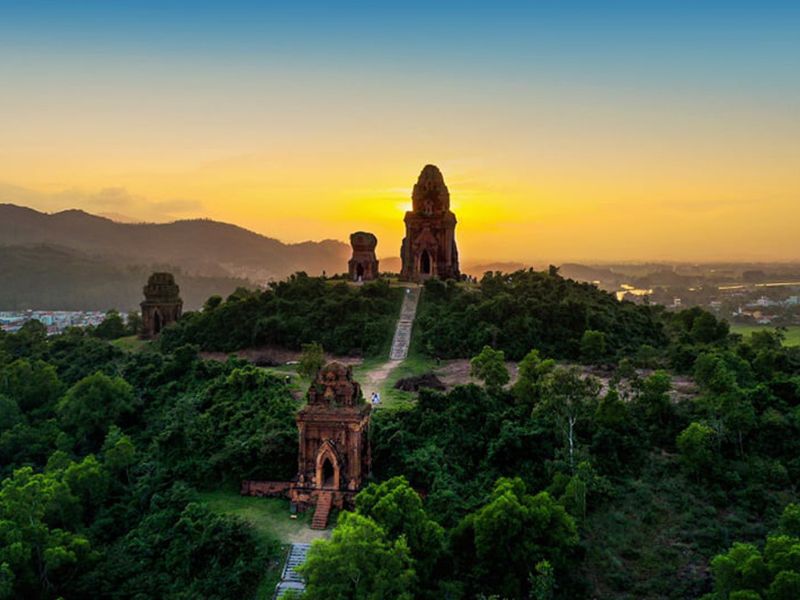
Banh It is a complex of four Cham Pa towers built in the 11th century, positioned on four low separate hillsides beside National Highway 1A in Tuy Phuoc District. According to Cham Hindu cosmological concepts, each tower corresponds to a spatial direction of the divine world — this layout indicates the complex was not individual temples but a complete sanctuary following the mandala model. The main tower (Gate Tower) is the largest and tallest, on the northern hill; Yen Ngua tower sits on the highest western hill; while the Fire Tower and Stele Tower stand on two lower southern hills. All four towers are built from fired Cham brick without mortar, with carved motifs of Shiva, Brahma, Apsara dancers and Kala demons.
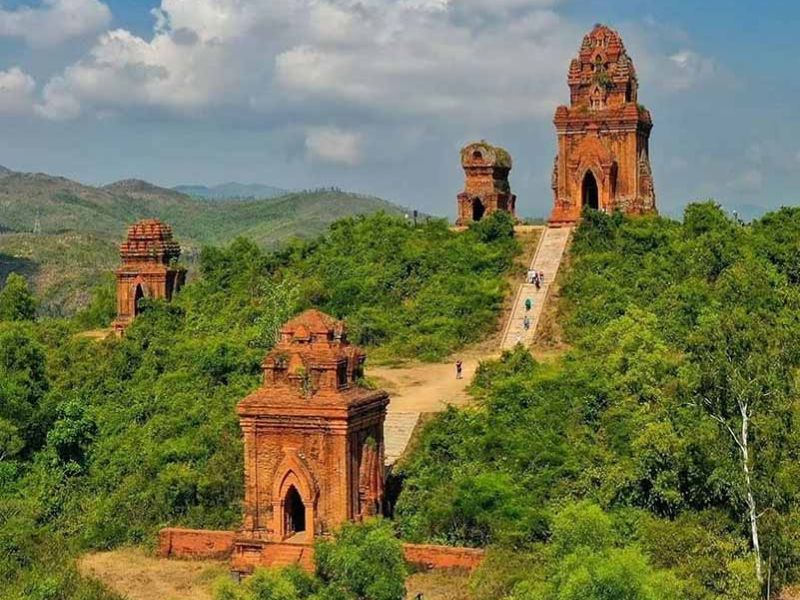
The name 'Bánh Ít' is one of the most charming folk stories in the Vietnamese absorption of Cham Pa heritage. When Vietnamese settlers moved around the Tuy Phuoc area after the 15th century, they looked up at the pointed conical Cham towers and saw them as identical to bánh ít (also called bánh ít lá gai) — the characteristic black pointed leaf-cake of central Vietnamese cuisine. That folk name attached itself to the Hindu sacred complex and holds to this day, both amusing and illustrating the natural process of cultural memory 'Vietnamisation'. In early 20th-century French and Vietnamese academic documents, the complex is named Thap Thi Thien — but no one uses that name in daily life.
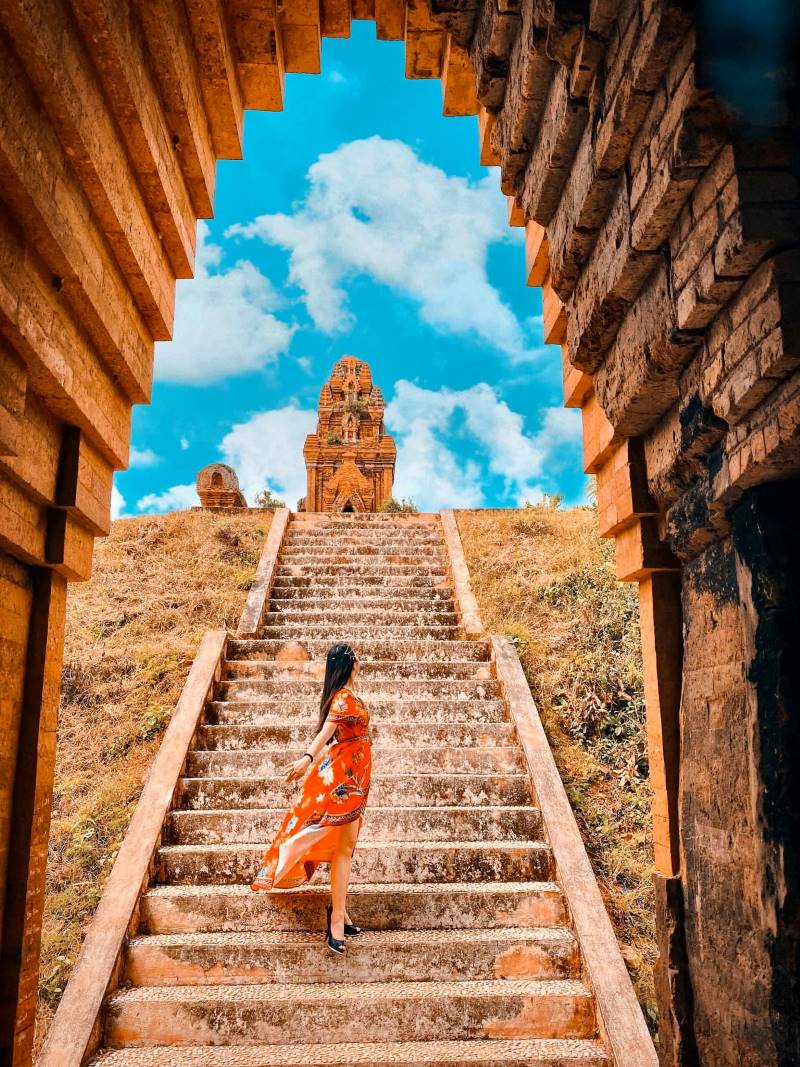
Each tower in the Banh It complex has distinct architectural and sculptural characteristics. The Gate Tower — the largest — has a wide base with small decorative columns and prominent Shiva bas-reliefs. Yen Ngua Tower — named because the roof profile from a distance resembles a saddle — has the most refined sculptural style in the complex. The Fire Tower and Stele Tower are smaller and more damaged, but still show the characteristic Cham brick technique with tightly fitted courses laid without mortar. Together the four towers on four hills create a heritage site viewable from multiple angles as you circle the complex.
Banh It towers stand beside National Highway 1A and are visible from a distance on the north-south train or road journey — which is why many people know the complex but few stop to visit properly. If you are on the Quy Nhon – Da Nang route or vice versa, Banh It is an ideal 1–1.5 hour rest stop — too short to be a primary destination but too beautiful to bypass when passing. Combined with Đồ Bàn Citadel (10km north) and Quang Trung Museum (a further 30km into Tay Son), you have a full Binh Dinh historical journey from Cham Pa to the Tây Sơn uprising in a single day.
"The Cham built towers to worship Shiva. The Vietnamese looked at them and saw rice cakes. Both are correct — they're just looking from two different cultures."
— Nguyễn Thị Hương, hướng dẫn viên di sản Bình Định
Highlights not to miss.
Gate Tower is the largest and most accessible tower, with elaborate base ornamentation and the main entrance facing east. Yen Ngua Tower on the western hill is architecturally the most impressive — distinctive roof profile and Apsara and Brahma carvings still clearly visible. Climbing Yen Ngua hill also gives a panoramic view across the entire tower complex and the surrounding Tuy Phuoc rice fields.
Unlike other Cham towers built in rows or clusters on the same hill, the four Banh It towers on four separate hills create a visiting experience of moving between hills. This also allows visitors to see the towers in spatial relationship to each other — nearly impossible when standing within a tightly grouped cluster. To see all four towers simultaneously, climb to a vantage point above the complex (ask the staff) or photograph from Highway 1A looking in.
The Banh It naming story is a concise cultural lesson in how Vietnamese people absorbed Cham Pa heritage not by erasure but by renaming in their own context. The academic name Thap Thi Thien is forgotten — the folk name Banh It lives on. This pattern repeats at many Cham sites across Binh Dinh: local people attach local names, familiar shapes or folk stories to the unfamiliar Hindu religious structures, gradually integrating them into community memory.
Standing on Gate Tower hill and looking west you will see the other three towers on their respective hills — this angle best reveals the mandala sacred precinct layout of the entire complex. Early morning before 8 AM the eastern light most clearly illuminates the bas-reliefs on the Gate Tower face.
How to visit & get there.
Getting to Banh It
Banh It sits directly beside National Highway 1A at km 1055, about 20km north of Quy Nhon — easily spotted from the road as four towers on separate hills. Motorbike or car from Quy Nhon takes 25–30 minutes. Small car park at the base of the main hill. Combine on the same day with Đồ Bàn Citadel (10km south) and Quang Trung Museum (30km west).
On-site Visit
Allow 1–1.5 hours to climb all four hills and examine each tower. Wear closed shoes — the paths up the small hills are unpaved and grassy. On-site staff can usually provide basic Vietnamese explanations of each tower. Yen Ngua Tower (west hill) requires 5 extra minutes of climbing beyond Gate Tower but rewards the effort architecturally.
Sources
- 1.Tháp Bánh Ít Bình Định — cụm tháp Chăm độc đáo trên đồi
Tạp chí Tổ Quốc · 2026-06-26
- 2.Tháp Bánh Ít — di tích Chăm Pa tại Tuy Phước, Bình Định
Tổng cục Du lịch Việt Nam · 2026-06-26